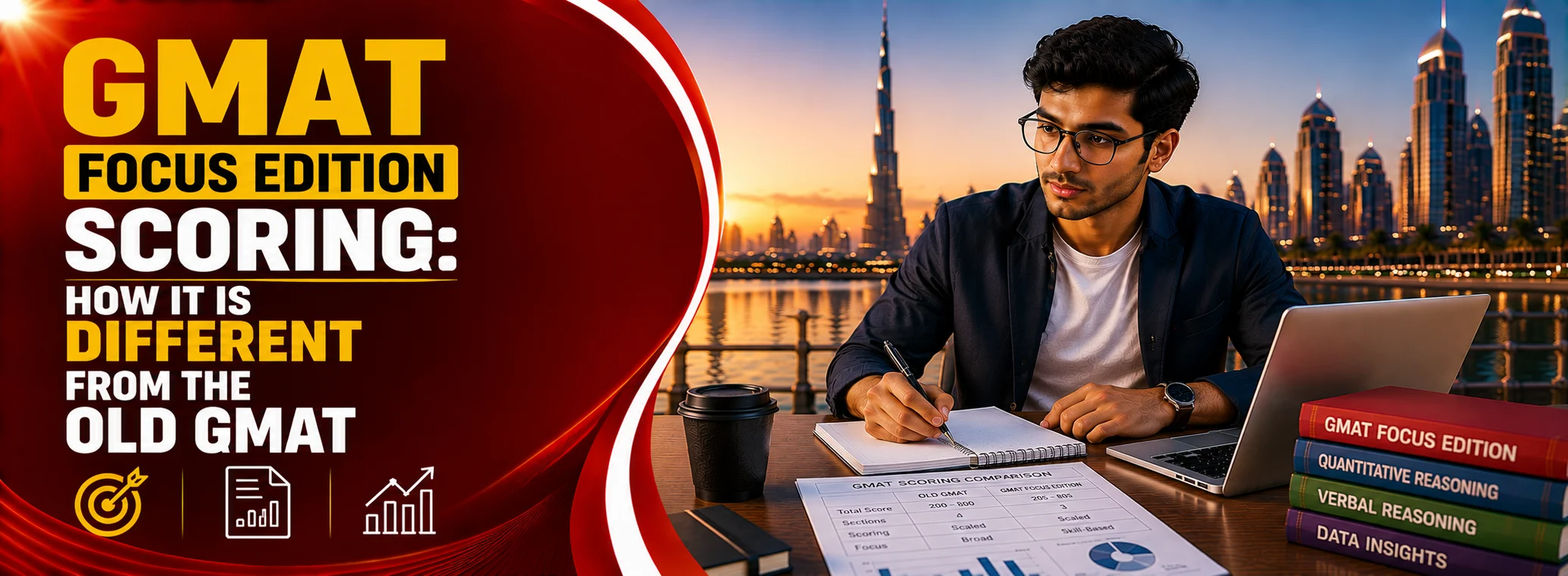
GMAT Focus Edition Scoring: How It Is Different From the Old GMAT
Quick Overview
The GMAT Focus Edition score goes from 205 to 805. It is made up of three equally important parts: Quantitative Reasoning, Verbal Reasoning and Data Insights. Each of these GMAT Focus Edition parts is scored from 60 to 90. If you get a 705 on the GMAT Focus Edition, you are in the percentile. If you get a 715 on the GMAT Focus Edition, you are in the percentile. A score of 645 on the GMAT Focus Edition is similar to a score of 700 on the old GMAT Focus Edition. The GMAT Focus Edition test takes 2 hours and 15 minutes to complete. The GMAT Focus Edition does not have a section. When you take the GMAT Focus Edition, you can see your score before you decide to send it to a business school.
| Metric | Old GMAT | GMAT Focus Edition |
|---|---|---|
| Total score range | 200–800 | 205–805 |
| Section scale | Varies (Quant/Verbal to 51) | 60–90 (all sections) |
| Test duration | 3 hr 7 min | 2 hr 15 min |
| Sections | Quant, Verbal, IR, AWA | Quant, Verbal, Data Insights |
So what? If you are looking at a school's "GMAT score" that was published before 2024 and comparing it to your own GMAT Focus Edition score, you are looking at two different number systems. Only the percentile shows the picture.
Key Takeaways
- The GMAT Focus Edition score ranges from 205 to 805. This is different from the score range of 200 to 800. Every total score for the GMAT Focus Edition ends with a 5.
- The Quant section and the Verbal section and the Data Insights section are all equally important. This is not like the GMAT, where your main score was based only on the Quant and Verbal sections.
- If you get a 705 on the GMAT Focus Edition, you are in the percentile, which is similar to getting a 750 on the old GMAT. If you get a 715 on the GMAT Focus Edition, you are in the percentile.
- The people who got into ISB's Class of 2026 had a GMAT Focus Edition score of 669. The people who got into Harvard's Class of 2027 had a GMAT Focus Edition score of 685. The people who got into INSEAD's class had a GMAT Focus Edition score of around 655.
- The GMAT Focus Edition test is shorter by an hour and it does not have an essay section. When you take the GMAT Focus Edition, you get to see your score before you decide to send it to any programme.
Introduction
Indian MBA applicants who are planning to take the GMAT in 2026-27 are having a lot of trouble. They look at the websites of business schools. They still see the average GMAT scores from before 2024. When they read the prep forums, they see new numbers all mixed up. Nobody really tells you why scoring a 655 on the GMAT now is better than scoring a 700 in two years. The people who created the GMAT, which is called GMAC, came up with a score system for the GMAT Focus Edition. This new system is not a new name; it is actually a different test from the old one. So when people think the new scores are the same as the ones, that is where they go wrong. Indian MBA applicants need to remember that the GMAT Focus Edition is a test.
The GMAT Focus Edition is what replaced the GMAT test in February 2024. If you are booking your test date now for the GMAT Focus Edition, you should know about the GMAT slot booking process and the documents you need to bring with you to the test. First you need to understand how the GMAT Focus Edition scoring works because that will help you figure out what score you should be aiming for on the GMAT Focus Edition. Getting the GMAT Focus Edition scoring right is important because it will decide what target score you should be trying to get when you book your test date for the GMAT Focus Edition.
What Is the GMAT Focus Edition Score?
Your GMAT Focus Edition score is a number that starts at 205 and goes up to 805. The scores are given in steps of 10 points. You will not see scores like 610 or 660. The scores are always in multiples of 10 points. So the scores that you will see are 605, 655 or 705. GMAC designed the scale like this on purpose. A total score that ends with a 5 makes it easy for any admissions officer to know that it is from the Focus Edition. It is not from the exam, which always ended with a zero.
This total score is made up of three sections. Each section is scored separately from 60 to 90.
- Quantitative Reasoning – tests data sufficiency and problem-solving without the heavy geometry the old exam included.
- Verbal Reasoning – tests reading comprehension and critical reasoning, with sentence correction fully removed.
- Data Insights – a newer section covering data sufficiency, table analysis, graphics interpretation, multi-source reasoning and two-part analysis.
Every section carries identical weight toward your total. This single change explains most of the confusion Indian applicants feel when they first see their GMAT Focus Edition score. Under the old system, a weak verbal score could sometimes hide behind a strong quant score, since quant and verbal alone drove the headline number. Under Focus Edition scoring, a weak section in any one of the three areas pulls your total down by the same amount, so lopsided prep no longer works the way it used to.
The exam itself also changed shape. It now runs 2 hours and 15 minutes against the old exam's 3 hours and 7 minutes, and the Analytical Writing Assessment essay is gone completely. You get 45 minutes per section, and you may take the three sections in whichever order suits your strengths, a flexibility the old GMAT never offered.
GMAT Focus Edition Score Chart: Percentiles at a Glance
Raw scores do not mean much on their own because GMAT Focus Edition scores need to be compared to others. The GMAT Focus Edition score is more useful when you know what percentile you are in. This tells you how your GMAT Focus Edition score compares to everyone who took the exam.
The people at GMAC update these percentiles from time to time when they get data from test takers. So your GMAT Focus Edition score can change a little over time. This happened recently when GMAC updated the scores in July 2025.
| GMAT Focus Edition Score | Approximate Percentile |
|---|---|
| 735 | 100th (highest reported) |
| 715 | 99th |
| 705 | 98th |
| 695 | 97th |
| 675 | 94th–95th |
| 655 | 91st |
| 635 | 80th |
| 605 | 70th |
| 555 | 48th |
For people who are applying, there are things that are really important to know. The difference between a score of 635 and a score of 695 is very big because it includes a range of percentiles from about the percentile to the 97th percentile. So if you gain ten points in that area, it has a big effect. If you have a score that's above 700, it does not have as much of an effect. A score of 715 is already at the percentile, which is what most top schools consider to be really good and a score of 705 is just a little behind at the 98th percentile.
GMAT Focus Edition Score vs Percentile: What Each Number Actually Means
Two applicants with the same total score can still stand in different competitive positions once their section-level percentiles come into play. A business school reviewing your file sees your total GMAT Focus Edition score vs. percentile position, but it also sees your three section percentiles individually, and a lopsided profile, say a strong quant paired with weak data insights, tells a different story than a balanced one.
This matters more now than it did on the old exam. Because Data Insights carries full weight, business schools reading your section breakdown pay close attention to it, particularly for finance and analytics-heavy MBA tracks. The same scaled section score can land at very different percentiles depending on which section it is, since Quant, Verbal and Data Insights each follow their own distribution among test-takers. INSEAD's own published admissions benchmarks illustrate this well:
| Section | Scaled Score | Approximate Percentile |
|---|---|---|
| Verbal Reasoning | 80 | 60th |
| Quantitative Reasoning | 80 | 66th |
| Data Insights | 77 | 66th |
Note that an identical scaled score of 80 sits six percentile points apart depending on whether it came from verbal or quant. If you are choosing where to put extra prep hours, the section pulling your percentile down the most usually deserves the attention, not the section you already feel confident about.
Old GMAT to GMAT Focus Edition Score: The Conversion Table
If you started preparing on old GMAT material, or you are trying to compare your result against a school's pre-2024 average, you need GMAC's official concordance table. This connects the retired 200–800 scale to the current 205–805 scale using percentile equivalence rather than a simple point-for-point conversion.
| Old GMAT (10th Edition) | GMAT Focus Edition Equivalent | Shared Percentile |
|---|---|---|
| 780 | 745+ | 100th |
| 750 | 705–715 | 98.0–98.8th |
| 700 | 645 | 87th |
| 650 | 605 | 71st |
| 600 | 555 | 46th |
| 550 | 515 | 30th |
So you want to compare scores on the GMAT and the new Focus Edition. The thing to remember is that a 700 on the test and a 645 on the Focus Edition are actually the same; they are both at the 87th percentile. This is really important to know if you are looking at class profiles because it means that getting a 645 in 2026 is just as good as getting a 700 in 2022; it is just a different way of measuring it.
How the GMAT Focus Edition Score Is Calculated
The scoring model behind your GMAT Focus Edition score runs on item response theory, a statistical approach that weighs both whether you answered correctly and how difficult that particular question was. A correct answer on a harder question moves your score up more than a correct answer on an easier one. This is why a simple GMAT Focus Edition score calculator based only on your number of correct answers will always be an estimate rather than an exact figure. The real algorithm adjusts for the specific difficulty path your test generated, and that path is unique to you.
The exam is fully computer-adaptive within each section. A correct answer typically triggers a harder next question, while an incorrect one lowers the difficulty. Your raw performance on each section then goes through GMAC's proprietary equating process, which converts it to the 60–90 scale, before the three section scores combine into your final 205–805 total.
One planning detail follows directly from this. GMAC removed the old lifetime limit of eight attempts back in October 2024, so you are no longer limited across your whole life, though you may still take the test only five times within any 12 months with a required 16-day break between tries as explained in the full rules about eligibility and how many times you can attempt it. You also get to see your score before choosing whether to send it, which means retaking the test has lower risk than it used to have.
GMAC removed the rule that you could only take the test eight times in your lifetime back in October 2024. Now the GMAC test has no lifetime limit on how many times you can take it. You can still only take the test five times in one year. You have to wait sixteen days before you can take the test again. They have rules about how many times you can take the test. You get to see your score on the GMAC test before you decide if you want to share it. This means taking the test again is not as big of a deal as it used to be.
GMAT Focus Edition Score for ISB, Harvard and INSEAD
Business schools have been publishing their Focus Edition numbers steadily since late 2025, and the picture for Indian applicants targeting ISB alongside global schools is now reasonably clear.
GMAT Focus Edition score for ISB: The ISB PGP Class of 2026 had an average of 669. The scores of those who were admitted varied a lot. Some had as low as 555 and others as high as 765. On the scale, the same group averaged 720. ISB does not set a minimum score. That means some people got in even if their GMAT score was below the average. Why? Because other parts of their application, their work experience and their interview were strong enough to make up for it.
To get into Harvard, people need to have a high GMAT Focus Edition score. For Harvard Business School's Class of 2027, the middle score that students had was 685. Most students who got into Harvard Business School had GMAT Focus Edition scores between 645 and 735. Harvard used to have a scoring system and the middle GMAT Focus Edition score was 730, which is pretty close to the new GMAT Focus Edition scoring system that Harvard is using now. The GMAT Focus Edition score is important for Harvard Business School.
The GMAT Focus Edition score people need to get into INSEAD is a bit different. INSEAD does not say what the minimum score is. They do give some advice. They say people should try to get a score around the percentile on the Verbal part and around the 66th percentile on the Quant and Data Insights parts. This means the total score should be around 655. This is pretty close to the score of around 700 to 710 that INSEAD used to see.
| Business School | Average / Median GMAT Focus Edition Score | Old-Scale Equivalent |
|---|---|---|
| ISB Hyderabad/Mohali (Class of 2026) | 669 | 720 |
| Harvard Business School (Class of 2027) | 685 | 730 |
| INSEAD | Approx. 655 | Approx. 700–710 |
The average GMAT Focus Edition score for ISB is the number most Indian applicants search for first, and it is worth repeating that ISB is currently one of the only Indian schools reporting a clean Focus Edition figure rather than an estimated conversion.
What Is a Good GMAT Focus Edition Score for You?
There is no single answer to "What is a good GMAT Focus Edition score?", since the honest answer depends entirely on where you are applying.
- 645 to 675: Competitive for most Indian schools accepting GMAT and several strong regional MBA programmes. Sits in roughly the 87th to 94th percentile band.
- 655 to 695: The realistic target zone for ISB, given the Class of 2026 average of 669 and the competitive threshold most consultants place around 655.
- 685 and above: Aligns with Harvard's median and puts you above the class average at most global M7 schools.
- 715 and above: The 99th percentile mark, treated as an elite score across nearly every top global programme, with 705 sitting one notch below at the 98th.
Your target should sit against the specific school's published data rather than a generic industry benchmark, since a 685 that looks strong for one programme may sit only at the class median for another.
Understanding Your GMAT Focus Edition Score Card and Unofficial Score Report
You receive an unofficial GMAT Focus Edition score report immediately after finishing the exam, showing your total score and all three section scores. This preview lets you decide on the spot whether to send that attempt to schools or keep it private and retake later. Your official GMAT Focus Edition scorecard, delivered afterwards through your account on the MBA website, adds detailed performance insights not available on the old exam, including a breakdown of how you performed across question types within each section.
Because you see your score before committing to send it, cancelling a score has become far less common than it used to be under the old reporting system. Schools only ever see the specific attempts you choose to share.
GMAT vs GMAT Focus Edition: What Changed for Indian MBA Applicants
Running a straight GMAT vs GMAT Focus Edition score comparison helps clarify why so much older prep advice no longer applies cleanly.
- Scoring scale: 200–800 becomes 205–805, and the new scale ends every score in a 5.
- Section weighting: Quant and verbal alone are used to drive your total. Now Quant, Verbal and Data Insights each count equally.
- Test length: 3 hours 7 minutes drops to 2 hours 15 minutes.
- Essay section: The Analytical Writing Assessment is gone entirely.
- Content removed: Sentence correction and most geometry no longer appear.
- Score preview: You now see your result before choosing to send it.
- Attempt limits: The old lifetime cap of eight attempts is gone, though the 12-month rolling limit of five attempts still applies.
For Indian test-takers who started prep before 2024, this list is worth reviewing carefully, since a study plan built around old-format materials will misjudge both timing and section balance under the current exam.
GMAT Expectations at UAE MBA Programmes
A strong GMAT Focus Edition score matters most once you point it at an actual programme, and Dubai's MBA market splits clearly into test-required and test-optional schools. IIM Ahmedabad Dubai runs its one-year MBA to broadly the same GMAT bar as its Ahmedabad campus, where overseas Indian applicants need at least 665 on the Focus Edition and foreign national applicants at least 645. Hult International Business School Dubai and S.P. Jain School of Global Management's Dubai campus also ask for a valid GMAT or GRE score, though neither publishes a hard cutoff; S.P. Jain's Global MBA cohorts have reported average incoming GMAT scores broadly in the 650 to 690 range in recent years, while Hult weighs professional work experience more heavily where a candidate's score sits below that range. Most other private universities across Dubai and the wider UAE remain test-optional, admitting students on academic record, a statement of purpose and an interview instead. The full breakdown of which UAE schools require a GMAT or GRE and which accept alternatives such as the CAT or GMAC's Executive Assessment sits on the GMAT exam guide.
Comparing MBA Programmes Beyond the GMAT Number
A GMAT Focus Edition score answers only one part of your MBA planning question. Which UAE business schools accept your score range, what tuition and return on investment look like against Indian and global alternatives, and how programme reputation stacks up regionally are separate research tasks entirely. Study From UAE's Compare Universities tool lets you set your score band alongside budget and location filters and see matching UAE MBA programmes side by side rather than checking each university website individually. If you are still narrowing down which programme fits your profile, the Find Your University Quiz takes your GMAT range, budget and career goals and returns a shortlist built around those inputs specifically.
Conclusion
The GMAT Focus Edition score system rewards balanced preparation across three equally weighted sections rather than strength in just one or two. A 645 today carries the same weight as a 700 did in 2022, and knowing that concordance number protects you from underestimating your own result when you compare it against older published averages. Once your target range is set against a specific school's data, whether that is ISB's 669 average or Harvard's 685 median, or a UAE programme's own GMAT expectation, your next planning step is matching that score against real programme options and realistic budgets. Run your profile through Study From UAE's ROI and budget calculator, or book a consultation with our team, to see exactly which UAE MBA programmes fit your GMAT Focus Edition score and financial plan before you commit to a test date.
 FAQs

 Previous Blog









 Log in with Google


