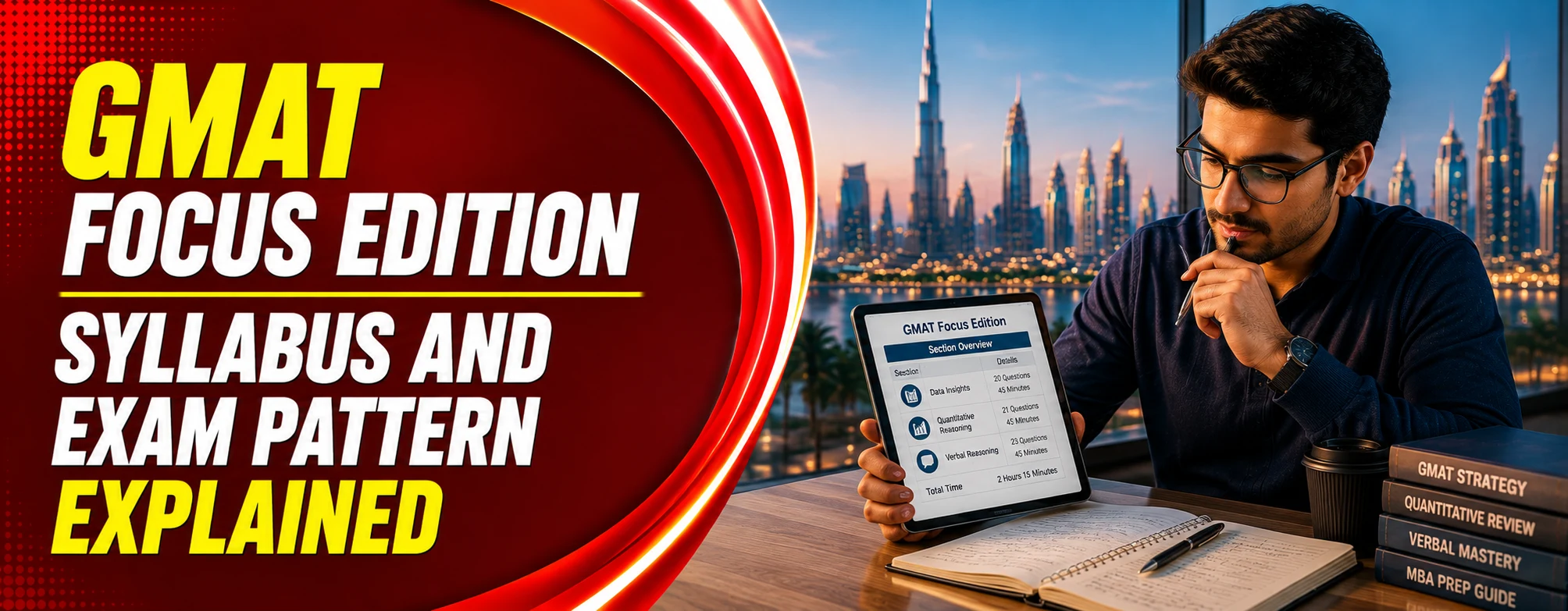
GMAT Focus Edition Syllabus and Exam Pattern Explained
Quick Overview
| Exam Element | Detail |
|---|---|
| Full Exam Duration | 2 hours 15 minutes (plus one optional 10-minute break) |
| Total Questions | 64 |
| Sections | Quantitative Reasoning, Verbal Reasoning, Data Insights |
| Quant Questions | 21 questions, 45 minutes, Problem Solving only |
| Verbal Questions | 23 questions, 45 minutes, Reading Comprehension and Critical Reasoning |
| Data Insights Questions | 20 questions, 45 minutes, 5 question formats |
| Total Score Range | 205 to 805 |
| Section Order | Selected by the candidate |
| Score Report Delivery | 3 to 5 days (occasionally up to 20 days) |
| Retake Limit | 5 times within a rolling 12-month period, 16-day gap between attempts |
| Superscore | Automatic, free, combines your best section scores across attempts |
| Delivery Mode | Test center or online |
Key Takeaways
- The Focus GMAT syllabus features just three sections. GMAC has excluded Analytical Writing Assessment and Sentence Correction from the syllabus completely.
- Quantitative Reasoning has Problem Solving questions in 21 and a duration of 45 minutes without using a calculator.
- Data Insights is a current, distinct section that GMAC introduced when it rebuilt the exam. It stepped into the role the separately scored Integrated Reasoning section used to play, and now carries equal weight with Quant and Verbal in your Total Score.
- The exam allows you to pick your own section order and edit up to three answers per section through the Question Review tool.
- You choose which single attempt's score gets sent to a school. Nothing is sent automatically, and any valid attempt from the past five years remains sendable. Since August 2026, your automatic Superscore now travels alongside whichever attempt you send.
- Indian students applying to UAE business schools benefit from the shorter, sharper format. Since August 2026, GMAT Superscore also gives you a second chance to look competitive if one section underperforms on a given day.
Introduction
The previous GMAT included a separate essay section and an Integrated Reasoning section, on top of Quant and Verbal. GMAC dropped both entirely when it rebuilt this exam. If you are researching the new GMAT Focus Edition syllabus for the first time, that single change explains most of the confusion floating around online. This covers the GMAT Focus Edition syllabus and exam pattern explained in detail, built entirely from GMAC's own exam documentation, along with GMAC's newly launched Superscore feature.
If you are targeting a UAE business school this year, this restructuring works in your favour. You spend less time in the exam chair and more time proving the skills that actually matter to admissions committees: data literacy, quantitative logic, and argument evaluation.
What Changed: GMAT Focus Edition Is Now Simply "The GMAT Exam"
GMAC dropped the "Focus Edition" label. This version is now called simply the GMAT Exam, since it is the only version GMAC delivers worldwide today. Most students and counsellors in India still search for it as the GMAT Focus Edition. Both names refer to the same test. This is explained by the mba.com FAQ page itself. "10th Edition" is used to denote the retired test that came into effect in 2012 and continued till February 1, 2024. Your score report, registration screen, and official documents show "GMAT Exam" rather than "Focus Edition." Do not feel confused if the labels look inconsistent across different websites.
This distinction matters for your preparation. Older prep materials built for the previous GMAT still float around online. Many still cover Sentence Correction and an essay section that no longer exists. Stick to GMAC's own GMAT Official Prep materials to avoid wasted study hours on retired content.
Here is a quick comparison to show exactly what moved between the two exam versions.
| Feature | Previous GMAT (10th Edition) | Current GMAT Exam (Focus Edition) |
|---|---|---|
| Sections | 4 (AWA, Integrated Reasoning, Quant, Verbal) | 3 (Quant, Verbal, Data Insights) |
| Essay Section | Included | Removed |
| Sentence Correction | Included in Verbal | Removed entirely |
| Total Score Scale | 200 to 800 | 205 to 805 |
| Exam Duration | Around 3 hours 7 minutes | 2 hours 15 minutes |
| Total Questions | 80 | 64 |
| Retired | Replaced February 1, 2024 | Current version |
The Study From UAE GMAT overview carries the complete official policy reference on this exam, including registration steps and test-centre details.
GMAT Superscore: What Changed in August 2026
GMAC announced Superscore on June 15, 2026, with a rollout targeted for early-to-mid August 2026. As of this writing, the feature is live or about to go live in your mba.com account. GMAT Superscore changes how a retake affects your application.
Here is what a Superscore actually does. GMAC automatically pulls your highest Quantitative Reasoning, Verbal Reasoning, d Data Insights score from across all your valid current-edition GMAT Exam attempts. These get combined into one composite figure, on the same 205 to 805 scale. You do not request this. It calculates on its own and appears in your mba.com account once you have more than one valid attempt.
A few specifics matter here:
- No opt-out exists. If a Superscore applies to you, it gets bundled automatically into your Official Score Report alongside whichever single attempt you choose to send.
- Full transparency for schools. Your score report shows exactly which exam date produced each section's best result, so admissions committees see the complete picture, not a hidden blend.
- Only current-edition attempts count. Scores from the retired 10th Edition GMAT do not feed into your Superscore.
- No separate percentile. A Superscore does not carry its own percentile ranking, since it is a composite built from your best individual sections rather than one sitting.
- School usage varies. Whether a program weighs your Superscore or your single-attempt score more heavily is entirely up to that school's own admissions policy.
For retake planning, this changes the math meaningfully. A retake now only needs to lift your weakest single section rather than your entire Total Score at once. Your strongest section scores from earlier attempts still count toward your Superscore. GMAC's own guidance does not publish a specific expected point gain for Superscore. It advises candidates to keep aiming for their best Section and Total Scores on every attempt, rather than banking on a projected uplift.
If a retake is part of your plan, factor in the current GMAT exam fees before you book a second attempt. Superscore does not waive the standard registration cost.
GMAT Focus Edition Syllabus 2026: Section-by-Section Breakdown
The syllabus of GMAT Focus Edition 2026 remains focused on three core sections of skills. Each one runs independently, carries its own 45-minute clock, and contributes equally to your Total Score. You get to attempt these sections in whatever order suits your strengths, which we cover further below. Our dedicated GMAT Exam Pattern and Syllabus page carries the exhaustive official reference on every question type. The breakdown here focuses on what each section actually feels like to prepare for.
| Section | Question Types | Count | Calculator Allowed |
|---|---|---|---|
| Quantitative Reasoning | Problem Solving | 21 | No |
| Verbal Reasoning | Reading Comprehension, Critical Reasoning | 23 | No |
| Data Insights | Data Sufficiency, Multi-Source Reasoning, Table Analysis, Graphics Interpretation, Two-Part Analysis | 20 | Yes |
GMAT Focus Edition Syllabus Quant: Quantitative Reasoning:
The GMAT Focus Edition arithmetic and algebra section tests your ability to apply logic in problem solving and also evaluates your mathematical skills. This section has 21 questions which should be answered in 45 minutes, and all the questions follow one pattern: Problem Solving.
Basic knowledge of mathematics and basic algebra is essential, although these questions are designed by GMAC in such a way that they test your analysis rather than simple calculation ability. No calculators are allowed during this section.
Topics that typically appear within this section include:
- Number properties and arithmetic operations.
- Ratios, percents, and proportions.
- Algebraic expressions, equations, and inequalities.
- Problems involving rates, work, and mixtures.
- Coordinate geometry ideas, which are considered algebra and not a separate subject.
Plane geometry, a constant feature of the old GMAT, is widely quoted to have been axed following the recent GMAC's 2023 test redesign. The current higher-level GMAC Exam Content page does not mention this specifically, but it should be regarded as well-substantiated rather than an officially GMAC-listed item. A standard Problem Solving problem could be, for instance, this one. Two trains depart from the same station on parallel tracks at the speeds of 60 and 75 kilometres per hour, respectively. In how many hours will they be 210 kilometres apart? As can be seen from this part's nature, pattern recognition pays off better than formula rote learning.
GMAT Focus Edition Verbal Syllabus: Verbal Reasoning:
The GMAT Focus Edition Verbal gauges your capacity to understand, analyze, and comprehend written arguments. It consists of 23 questions to be completed within 45 minutes and contains two types of questions: Reading Comprehension and Critical Reasoning. Sentence Correction, which was part of the older GMAT format, is not included in this test anymore.
Questions on Reading Comprehension will evaluate your comprehension of ideas, support, reasoning, inference, and tone in a passage. It will be necessary for you to follow the progression of an argument, even in those passages which refer to quantitative ideas.
In Critical Reasoning, there is a short text of less than 100 words, and then there is a question that asks you to either support, refute, or judge the logical reasoning in the argument. The typical format will be that the profit of a company increased after reducing advertising expenses. It then asks you to identify the fact that most weakens the claim that cutting advertising caused the profit increase. No prior knowledge of the subject matter is required to answer these right. What is needed is the capacity to recognize assumptions and lapses in logic.
Verbal portions tend to be unnerving for candidates who are not accustomed to reading comprehension that is heavy on English arguments. The silver lining is that this portion favours logic over vocabulary skills.
GMAT Focus Edition Syllabus: Data Insights:
Data Insights is a current, standalone section with its own five question types, not simply a renamed version of the older Integrated Reasoning section. It stepped into the role IR used to play in the exam structure and now stands as one of the three core, equally weighted sections. It measures your ability to analyze data from multiple sources and apply it to realistic business decisions, a skill GMAC calls digital and data literacy. This section carries 20 questions in 45 minutes, and it is the only section where an on-screen calculator becomes available to you.
Five question formats appear within Data Insights:
- Data Sufficiency: Determines whether given data is enough to solve a quantitative problem.
- Multi-Source Reasoning: Tests your ability to conclude text, tables, and graphics presented together.
- Table Analysis: Requires sorting and interpreting spreadsheet-style data tables.
- Graphics Interpretation: Asks you to read bar charts, scatter plots, or statistical curves and draw inferences.
- Two-Part Analysis: Presents complex quantitative or verbal problems requiring you to evaluate trade-offs or solve simultaneous conditions.
A typical Table Analysis question gives you a sortable table of a retail chain's monthly sales across ten stores. And then it wants you to tell which stores have performed better than their regional average in exactly two out of the past three months. Mastery of this format of questions is achieved through consistent practice because it requires both numerical and verbal skills – something that was not covered by the old GMAT.
Need an individualized assessment of which section requires your focus most? Book a free consultation with our counselling team. We will map your prep plan against your target UAE business school.
Planning to Study in the UAE? Let Us Guide You the Right Way.
GMAT Exam Pattern Explained in Detail
Beyond the syllabus, GMAC redesigned the entire test-day experience to feel less rigid than the older format. Four features define the current GMAT Focus Edition syllabus and exam pattern, explained in detail on mba.com.
- Section Order Selection: You decide the order of tackling each of the three sections. The advantage is that you can begin with the one you find easiest, or the one that you find the most difficult but when you are most focused.
- Optional Break: Your schedule will include one 10-minute break, which you can choose to take either after your first session or after your second. Not taking the break is another possibility.
- Question Review and Edit: Within each section, you get the option to bookmark questions for later review and change up to three answers before time runs out. This single feature reduces the anxiety of committing to an answer under pressure, since a genuine safety net exists.
- Flexible Score Sending: You select which schools receive your official score only after you see your unofficial result. Nothing gets sent automatically before you decide.
The full appointment, including check-in, runs close to two and a half hours. Test centers and online delivery follow identical content and timing, so your choice comes down to convenience and comfort rather than difficulty. Before test day, run through our documents checklist for Indian candidates. A passport mismatch at check-in is an avoidable but recurring cause of a wasted appointment.
Scoring Pattern and What Your Score Means
Your GMAT Exam performance produces four numbers: A Total Score, as well as individual scores in Quantitative Reasoning, Verbal Reasoning, and Data Insights. Each section is given equal importance to arrive at the Total Score, marking a departure from the old test where Quant and Verbal had more clout.
Total Scores can fall between 205 and 805, unlike the older scale, which spanned 200 to 800. As the scales are different, a direct comparison between a Focus Edition Score and one from before 2024 would be unfair. GMAC publishes an official score concordance table for this exact comparison. Per GMAC's published table, a classic score of 700 corresponds to a Focus Edition range of roughly 645 to 655, at the 86.7th to 90.5th percentile.
Within three to five days of finishing your exam, your Official Score Report becomes available through your mba.com account, occasionally taking up to 20 days. This detailed report breaks your performance down by section, content domain, question type, and time management patterns. It gives you genuine insight into where your retake prep should focus. Since August 2026, it also displays your Superscore alongside your chosen single-attempt result, if you have taken the exam more than once.
Curious how a stronger GMAT score translates into scholarship value or ROI at a UAE business school? Run the numbers through our ROI Calculator before you commit to a test date.
Is studying in the UAE worth it?
Check your starting salary, savings in ₹, and recovery timeline in months. Built for Indian subcontinent students.
Calculate ROI NowWhy the GMAT Focus Edition Syllabus Matters for UAE-Bound Indian Students
UAE business school requirements around the GMAT vary program by program rather than following one blanket rule. Some programs, including Hult International Business School and SP Jain School of Global Management, typically expect a GMAT or GRE score as part of the application. Many private universities across Dubai and the wider UAE, by contrast, do not require a GMAT score at all, weighing your undergraduate record, work experience, and interview performance instead. Executive MBA programs in the region frequently waive the test requirement entirely for candidates with substantial work experience. Every score from a test taken since February 2024 sits on the current 205 to 805 scale. Worth noting: since GMAT scores stay valid for five years, some UAE applicants are still presenting classic-scale scores taken shortly before the 2024 changeover. Do not assume every score you see quoted uses the current scale until you check the test date.
The compressed, three-section format also suits working professionals from India who study for the GMAT alongside a job. The exam itself runs nearly an hour shorter than the older four-section format, which leaves more room in a working professional's schedule for other application work. This efficiency matters when balancing exam prep against visa research, university shortlisting, and scholarship applications, all of which move faster with structured guidance.
GMAT-linked scholarship policies vary widely from one UAE business school to another. Treat any specific band or cutoff you read online with caution until you confirm it directly with the university. A lower score need not close every door, since several UAE programs waive the GMAT requirement entirely for candidates with strong work experience.
Retake Rules and Eligibility Requirements
GMAC sets clear boundaries around who tests and how often. You must be at least 18 years old to register independently. Candidates between 13 and 17 years old get permission to test at a center with written parental or guardian consent.
GMAC allows up to five attempts at the GMAT Exam, across test centres and online delivery combined, within any rolling 12-month period. A minimum gap of 16 days separates two consecutive attempts. If you score a perfect 805, GMAC requires a five-year wait before you test again. These caps exist to protect score integrity. Superscore is now rolling out, so a retake carries more potential upside than before, since even a section-only improvement strengthens your composite result.
Indian students juggling college semesters and application deadlines need to treat this retake structure as a planning tool, not a safety net. We recommend booking your first attempt at least four months before your earliest application deadline. This leaves space for one considered retake if your first score falls short of your target program's average. Our dedicated GMAT Retake Policy page carries the complete, continuously updated policy detail, including edge cases around cancelled or expired scores.
How to Prepare for Each Section of the GMAT Focus Edition Syllabus
Knowing the GMAT Focus Edition syllabus and exam pattern explained in detail is only step one. Turning that knowledge into a study plan makes the real difference on test day. Here is a practical, section-wise approach that works well for Indian students balancing college coursework or a full-time job alongside GMAT prep.
Start with GMAC's own GMAT Official Starter Kit, available free through your mba.com account. It includes two full-length practice exams built on the actual algorithm, giving you an honest baseline score before you invest in additional resources. Retaking a diagnostic every three to four weeks helps you track genuine improvement rather than guessing at your readiness.
Quantitative Reasoning prep works best around timed problem sets practised daily instead of untimed ones. Since a calculator stays off-limits here, rebuild your mental math speed for percentages, ratios, and basic algebra early in your prep cycle. Twenty focused minutes daily beats a single three-hour weekend session for this section specifically.
Verbal Reasoning improves fastest through daily business journalism, even ten minutes of a well-structured op-ed. Reading Comprehension rewards familiarity with dense, argument-driven text, and Critical Reasoning rewards spotting logical gaps quickly. Building this habit early feels almost as smooth as scrolling through your morning news feed back home. Except now, you are training your brain to catch flawed arguments on sight.
Data Insights prep benefits from interpreting tables and graphs pulled from real business news sources, not just GMAT-style questions. This section measures how comfortably you translate scattered information into a decision, a skill that improves fastest through varied, real-world exposure rather than repetitive drilling.
If you are weighing the GMAT against the GRE for your UAE applications, most programs that accept one accept both. The decision usually comes down to which exam format suits your strengths, not which one schools prefer.
Finally, take at least two full-length, timed mock exams under realistic conditions before your actual test date. Sitting through the complete two-hour-fifteen-minute format, including your chosen section order and optional break, builds stamina and pacing instincts that topic-wise practice alone never teaches you. Once your prep plan is in place, use our University Finder Quiz to shortlist UAE programs that fit your target score range and specialization.
Conclusion: Plan Your GMAT Exam Prep With Confidence
The GMAT Focus Edition syllabus rewards focused, skill-based preparation over rote memorization. Three sections, 64 questions, and a scoring system that treats Data Insights as seriously as Quant and Verbal. This exam gives you a fair, transparent measure of your readiness for a UAE business school, and the new Superscore feature makes a well-planned retake more worthwhile than ever. Understanding the exact syllabus and pattern before you book your test date saves you weeks of misdirected prep.
Study From UAE has guided thousands of students from the Indian subcontinent through exactly this decision point. Our support spans everything from choosing a test date to shortlisting the right business school across Dubai, Abu Dhabi, and Sharjah. Do not navigate this alone. Once you are ready to lock in a date, our step-by-step GMAT registration guide walks you through the mba.com booking process. Or reach out directly, and let our counselling team build a GMAT-to-admission roadmap tailored to your target UAE program.
 FAQs

 Previous Blog









 Log in with Google


