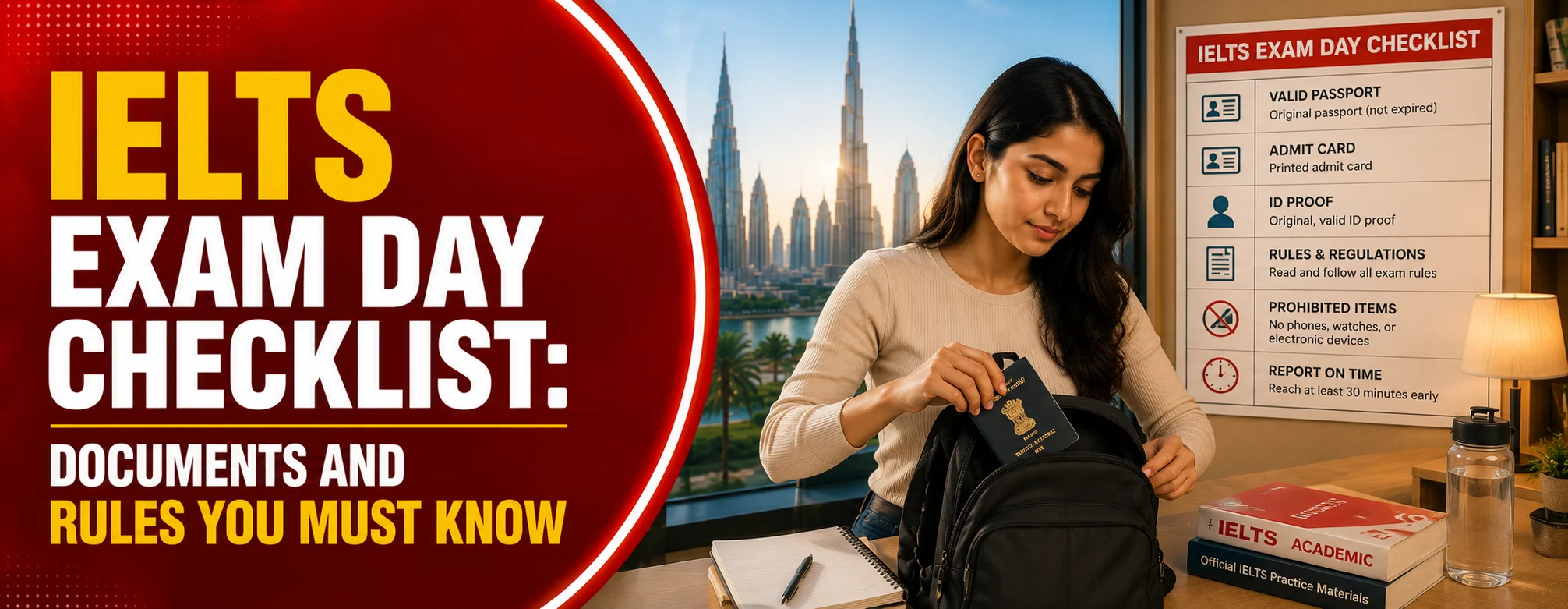
IELTS Exam Day Checklist: Documents and Rules You Must Know
Quick Overview
| Quick Facts | Detail |
|---|---|
| ID required | Passport or national ID (same as registration) |
| Exam fee (2026, India) | INR 19,000 (Academic and General Training) |
| Total test duration | Around 2 hours 40 to 45 minutes |
| Arrival time | 30 to 60 minutes before your slot |
| Items not allowed | Phones, electronic devices, bags, wallets, watches |
| Family or friends inside venue | Not permitted |
| Result validity | 2 years |
Key Takeaways
- Your IELTS exam day documents required list starts and ends with one valid photo ID. Nothing else carries the same weight.
- Electronic devices, bags, and valuables stay outside the test room, and are not allowed even by mistake.
- Paper-based and computer-delivered IELTS follow different stationery and note-taking rules, part of the wider IELTS test day rules and regulations.
- Breaking test decorum, even without intent to cheat, can lead to withheld results.
- The IELTS exam fee in India for 2026 is INR 19,000, unchanged across cities and formats.
Introduction
What actually happens if you get one small detail wrong on IELTS exam day? In the case of most Indian students, it is not just the cost of INR 19,000 for retaking the test. It is more than that, as you could be missing an intake at UAE universities, as most of the universities consider the scores only a couple of times in a year.
Every year, thousands of highly-prepared students either fail or miss out on their attempt not because of a lack of language skills in English but due to their ID being lost, carrying incorrect stationery, or just being unaware of a particular regulation. There really is no need for such a thing.
This guide shows you how to prepare yourself for the exam on the examination day; the proper documentation, the correct procedures, and the correct format of the test to get the score that you deserve.
Documents Needed at Registration vs Exam Day
The two phases require separate documentation; getting the two confused leads to most of the last-minute panics.
Registration requires a valid passport, correct personal information according to the passport, and evidence of payment after the payment goes through. Some offline routes also ask for a passport-sized photo. Walk through the full IELTS registration process on our site if you have not booked yet. At the exam itself, only one document truly matters: the same one you registered with.
Not sure about the exact score required for your target university? Book a free consultation with our team of experts and have clear information on the score before you appear for the examination.
Planning to Study in the UAE? Let Us Guide You the Right Way.
Documents Required on IELTS Exam Day
Your identification document is the single most important thing to carry. It has to be the same passport or national ID used at registration. Staff checks it at entry, and your Speaking test examiner checks it again before your interview. You do not need passport-sized photographs, since the centre photographs you at check-in.
If you have been wondering what to carry for IELTS exam day, or which documents are required for the IELTS exam, the honest answer is fewer than you think. Here is the complete list of IELTS exam day documents required, which doubles as your core IELTS exam day requirements:
- Valid photo ID: Original passport or national ID, not expired, matching your registration details exactly.
- Test confirmation email or admit card: Not mandatory everywhere, but a saved copy on your phone (shown before switch-off) saves time at check-in.
- Minors: A parent or legal guardian's valid ID must reach IDP before test day, or you will not be permitted to sit the test. Check our Eligibility Criteria page if registering for a younger family member.
Never rely on a driving licence, voter ID, or any other document. If your ID does not match, the centre can turn you away, and your IELTS exam fee is not automatically refunded.
Keep your ID in an easily accessible pocket rather than buried inside a bag you hand over for storage, since a fumbled search at the entrance adds stress. Photocopies do not count either. Test centres check the original only, and a scanned copy will not help once your phone is switched off.
Note: If your name spells differently across your passport and your UAE application, even by one letter, admissions teams often ask for a notarised affidavit before processing your offer. Match every spelling now, not after your offer letter arrives.
What You Cannot Bring Into the Test Room
The IELTS exam rules around personal belongings are strict, and centres apply them without exception.
You can carry:
- Your registered photo ID
- A clear, label-free water bottle
- Your confirmation email or admit card
You cannot carry:
- Mobile phones or any electronic device
- Bags, wallets, and keys
- Watches, smartwatches, and fitness bands
- Food of any kind
- Valuable personal items
- Glasses cases (the glasses themselves usually stay with you if needed for reading)
You will need to turn off your mobile phone prior to entry and leave it in a safe place along with your other possessions, organized by the supervisor. Most centres do not have any liability in case of loss of items, so pack a minimum of items in your bag while carrying them to the test centre.
Stationery Rules: Paper-Based vs Computer-Delivered IELTS
What should you bring to an IELTS computer-delivered test? Well, if you have ever asked yourself that question, you need not worry anymore, because there is a very easy answer to this question. There is no need to bring any stationery, as the center provides you with notepaper and a pencil.
For IELTS on Paper, the rule depends on who administers your test. IDP IELTS India, which runs most Indian test centres, confirms that candidates have to bring their own stationery: two pens, two HB pencils, an eraser, and a sharpener. The British Council India follows different rules for the exam: the centre supplies a black ball pen; personal stationery, including pencils, are not permitted inside the test centre. Since IELTS in India is booked overwhelmingly through IDP IELTS India, carrying your own pens, pencils, and eraser is the right option to reduce last-minute harassment. If your booking confirmation names British Council India instead, follow their guidance and rules to travel without stationery from home.
Regardless of your choice, your answers to the Reading and Listening tests in the paper-based test have to be transferred to the answer sheet, where only pencil writing is allowed. Anything written on the question paper is not scored.
Check-In and Arrival: What to Expect
Get to your test center 30-60 minutes before your allotted time. IDP India advises you to be there 30-45 minutes before, whereas the other platforms advise you to come an hour before your allotted time in case your test center is busy. This buffer covers ID verification, photography, and sometimes a biometric scan.
Here is the walkthrough, which doubles as your core IELTS exam day instructions:
- Reach the centre with your ID and confirmation email ready.
- Complete security checks and hand over your belongings for storage.
- Staff verify your ID and take your photograph for the Test Report Form.
- You get seated, with instructions from the invigilator.
- In case of computer-based tests, noise-cancelling headsets and on-screen timer are provided to you
In case you report late, there is no chance of your sitting for the test and you do not receive any refund of the fee. Treat your reporting time as fixed, not flexible.
Two details catch most first-timers off guard. There are no breaks between Listening, Reading, and Writing, so plan your last meal and washroom visit beforehand. And check your exact test location a week ahead, since it can differ from the centre you originally booked.
Rules and Decorum During the Test
The IELTS exam day rules protect the fairness of every candidate's score, and invigilators enforce these IELTS rules and regulations 2026 without negotiation. During the test, you must not:
- Cheat, copy another candidate's work, or disturb the room
- Use a dictionary, translator, smartwatch, or electronic device
- Lend or borrow anything from another test taker once seated
- Talk to or signal other candidates after the test begins
- Eat or smoke inside the examination hall
- Reproduce or memorise test content, which can lead to prosecution
- Carry test material out of the room
- Leave your seat without the invigilator's permission
If you break any of these rules, your result gets withheld, and the institution you nominated to receive your score is informed of the violation. This is not a warning system. A single serious breach is often enough.
If something affects your performance, such as noise or feeling unwell, raise your hand and tell the invigilator immediately, since raising it after usually closes that door. You can also raise your hand for the washroom during most of the test, but not Listening, since the recording plays only once.
Study From UAE Context: If a university already has your provisional offer on file and your score gets withheld over a rules breach, you risk unraveling a scholarship deadline tied to that score, since scholarship windows run tighter than admission windows.
Section-Wise Rules You Should Know
Each of the four IELTS sections carries its own small print, worth knowing in advance so you do not lose marks over technicalities.
- Listening (around 30 minutes): Recordings play only once. On the computer, you type answers directly. On paper, you get 10 minutes after the recording to transfer answers to the official answer sheet, a step that does not exist after Reading.
- Reading (60 minutes, 40 questions): On computer, you can highlight text and take on-screen notes. On paper, every answer must go onto the separate answer sheet in pencil, since the question booklet alone is not marked.
- Writing (60 minutes, two tasks): Task 1 needs at least 150 words, Task 2 needs at least 250. Full sentences only; bullet points are not accepted, and memorised "model answers" are flagged and can invalidate your test.
- Speaking: This may happen the same day or separately, either face to face or by video, depending on your centre. The same ID check applies here too.
Note: For UAE programmes in Business or Engineering, some admissions committees weigh your Writing sub-score on its own, not just your overall band. A rushed Task 2 can dent that sub-score even when your average still clears the bar.
Family and Companions on Test Day:
No children or relatives are allowed entry into the IELTS testing venue under any circumstances, even waiting inside. If anyone drops you off or picks you up from the IELTS venue, they will have to wait outside until completion of the exam. This applies across paper and computer formats, with no exceptions for young children or elderly companions.
IELTS One Skill Retake: A Quick Note
When you fail any of these four aspects precisely, the option of IELTS One Skill Retake allows you to take a retest in only that segment rather than doing it for the whole exam. The price for this is INR 12,650 for India in 2026, which is much lower than the whole test retake price, i.e., INR 19,00. It is available only on eligible computer-delivered tests, not paper, and only once per attempt. Eligibility depends on your centre and the organisation you are applying to, so confirm before assuming it works for your UAE application. Read our full IELTS retake policy before you decide.
If Writing alone is pulling your band down, the One Skill Retake can close that gap in days. A full retake cycle can take six to eight weeks, a window that does not always exist before a UAE intake closes.
IELTS Exam Fee in India for 2026
Here is the current fee structure, so there are no surprises:
| IELTS Test Type | Fee (2026) |
|---|---|
| IELTS on Paper | INR 19,000 |
| IELTS on Computer | INR 19,000 |
| IELTS on Computer for UKVI | INR 19,250 |
| IELTS for UK Visas and Immigration | INR 19,250 |
| IELTS Life Skills (A1 and B1) | INR 18,000 |
| One Skill Retake | INR 12,650 |
Charges remain the same in all Indian cities, whether Delhi, Mumbai, Bangalore, Hyderabad, Chennai, Pune, or Kolkata. Remember that the validity period of IELTS score is two years; therefore, time your journey to the UAE accordingly.
Results arrive at different speeds too. Computer results land in 1 to 5 days; Paper takes up to 13, worth remembering if your UAE deadline is close. See the full IELTS exam fees breakdown on our site.
What Happens If You Miss a Rule
Small mistakes carry real consequences. Arriving without your ID, carrying a phone in, or writing answers only on the question paper can cost you the entire attempt, with no automatic refund of your IELTS exam fee. A single oversight can cost the full INR 19,000 and push your UAE application back by weeks. Compare that to the One Skill Retake fee of INR 12,650 for a genuine band gap, and the difference between a preventable mistake and a fixable gap becomes clear.
A written checklist reviewed the night before is far better than just depending on your memory. Browse through our IELTS preparation guide for band score tips and UAE specific university requirements.
Why Exam Day Discipline Matters for Your UAE Plans
This is not just about test rules. It is about your university admission timeline, and every hour lost to an avoidable mistake is an hour taken from that timeline.
A band score earned cleanly moves your UAE application forward without delay. The requirements vary depending on the university and program: the Band requirement for certain University of Dubai undergraduate courses is 5.0, while others are 6.0; meanwhile, Heriot-Watt University Dubai requires 6.0 for undergraduate courses and 6.5 for postgraduate courses. Please see our universities in UAE accepting IELTS page for further confirmation.
Think of your exam day checklist the way you would think of your visa document folder: every item has a purpose. This is the lens Study From UAE counsellors use with every student: not "did you pass IELTS", but "does this score still fit your intake window".
Conclusion
Your IELTS test day checklist basically boils down to these three key points: ID, distraction-free pockets, and knowledge of test format rules. Master all these points, and you will get a score that represents your level of English fluency and not some unnecessary mistake at the testing center entrance.
If you are aiming for a UAE degree, the IELTS band score that you achieve is only one of many things that need to come together for this to happen. Do not navigate it alone.
Start with our free ROI Calculator to check your target band score and budget against real UAE programmes, and map your score to the right course, university, and intake for targeting the exact university with its required IELTS score.
Is studying in UAE worth it?
Check your starting salary, savings in ₹, and recovery timeline in months. Built for Indian subcontinent students.
Calculate ROI Now
 FAQs

 Previous Blog









 Log in with Google


