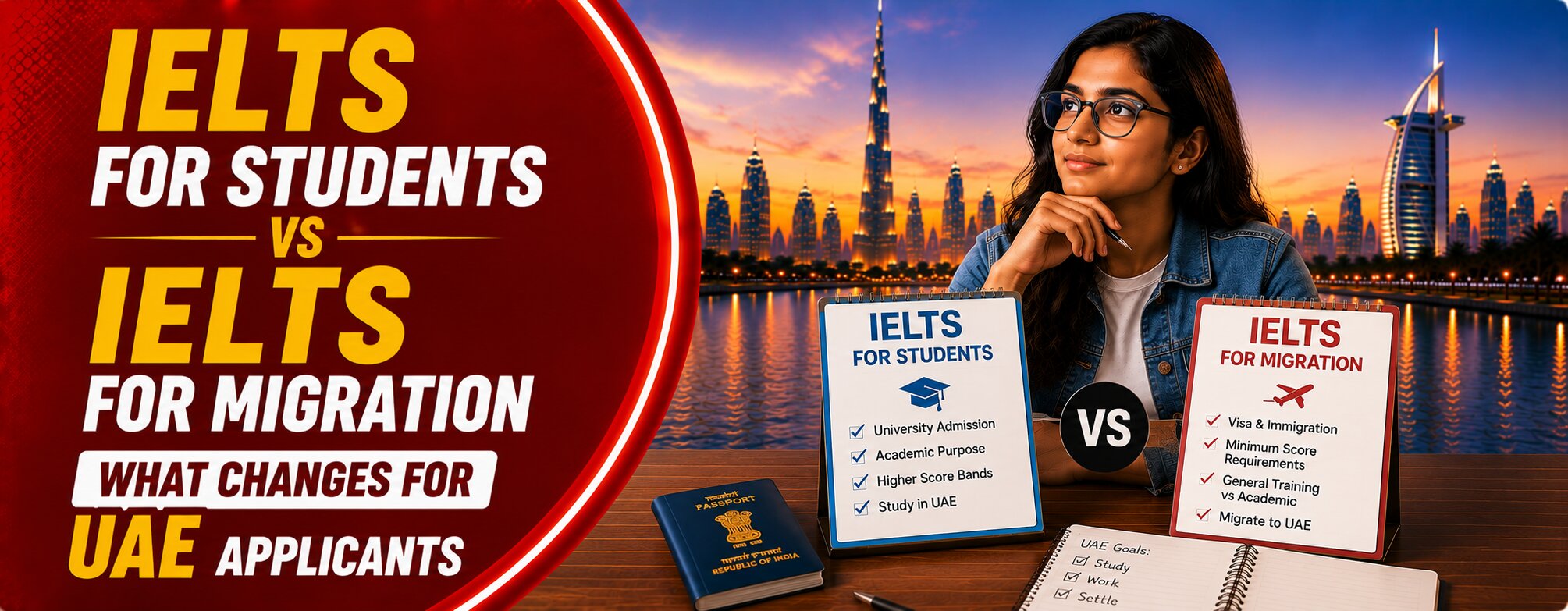
IELTS for Students vs IELTS for Migration: What Changes for UAE Applicants
Quick Overview
Before you compare band scores and fees, it helps to see the two tests side by side, along with where a UAE university admission actually fits into the picture.
| Factor | Details |
|---|---|
| Test for university study | IELTS Academic |
| Test for migration or PR | IELTS General Training |
| Sections that differ | Reading and Writing |
| Sections that stay the same | Listening and Speaking |
| Exam fee in India (2026) | INR 19,000 for both Academic and General Training; INR 19,250 for IELTS for UKVI, effective 1 April 2026 |
| One Skill Retake (OSR) fee | INR 12,650 for a single section, where accepted |
| Score validity | 2 years from the test date |
| Accepted for UAE university admission | IELTS Academic |
| Typical UAE undergraduate band requirement | 5.5 to 6.5 overall, varies by university |
| Other accepted proficiency tests in UAE | TOEFL iBT, PTE Academic, Duolingo English Test, and in some cases an MOI waiver for CBSE or ICSE students |
Key Takeaways
- For admissions in the UAE, you need to take IELTS Academic as General Training is not accepted for admissions.
- You do not necessarily need to take the IELTS test because now the universities accept the TOEFL iBT test, PTE Academic test. A lot of universities are now accepting the Duolingo English Test for admissions.
- Some Indian students can skip the test entirely. A Medium of Instruction (MOI) letter from a CBSE, ICSE or state board school is accepted by several UAE institutions in place of a fresh test, though this is university-specific.
- Booking the wrong test type is a costly, fully avoidable error. A repeat attempt means paying the full fee again, since IELTS does not allow a switch after registration.
- The One Skill Retake (OSR) can save you money. If you fall short in one section only, resitting that section alone costs INR 12,650, though not every university accepts OSR results.
- A UAE student visa does not itself require a separate English test. Your university's admission clearance, which usually depends on your IELTS Academic score, is what carries the visa process forward.
Planning to Study in the UAE? Let Us Guide You the Right Way.
Introduction
Ever wondered why two Indian students, both with a Band 7 IELTS score, ended up applying for completely different things, one for a university offer in Dubai and the other for a migration application overseas? The answer usually comes down to a single word on their registration form. As of 1 April 2026, the IELTS exam fee in India stands at INR 19,000 for both test types, yet applicants planning a UAE education still book the wrong version more often than you would expect. This usually happens because an agent's advice about "the migration test" gets mixed up with what a UAE admissions office actually requires.
This confusion sits at the heart of IELTS for students vs IELTS for migration, and for Indian students applying to universities in Dubai, Abu Dhabi, Sharjah or any other emirate, getting it right the first time matters. In this guide, we explain what changes between the two versions, which one your UAE university actually needs, what band score to expect, and how Indian students can sometimes avoid the test altogether through an MOI waiver. Let us begin.
IELTS Academic and IELTS General Training: Two Tests, One Name
The IELTS test comes in 2 types and has different purposes even though they are issued by the same organisation.
The IELTS Academic test checks if your English is good enough to study at a university. All universities, including the ones in the UAE want to see the IELTS Academic results.
The IELTS General Training test checks how well you can use English in your everyday life and at your job. The IELTS General Training test is the one that immigration departments and some employers look at when they decide if they should give someone a visa or let them stay in a country. The IELTS General Training test is important for people who want to live and work in another country.
Both IELTS Academic and IELTS General Training use the scoring system from 0, to 9 and the same institution gives out the test results. That is why people get confused about IELTS.
The difference lies entirely in what each test is designed to prove. You can see the full format, fees and band-score breakdown in our complete IELTS exam guide.
What Actually Changes: Reading and Writing
Two of the four sections change depending on which version you sit.
| Section | IELTS Academic | IELTS General Training |
|---|---|---|
| Reading | Three passages from academic journals, textbooks and research-style articles | Everyday texts such as notices, advertisements and workplace handbooks |
| Writing Task 1 | Describe a graph, chart, table or diagram in 150 words | Write a formal or informal letter in 150 words |
| Writing Task 2 | 250-word essay on a general topic | 250-word essay on a general topic |
Listening and Speaking: What Stays the Same
It does not matter which test you choose- you listen to the same Listening section and have the same speaking interview with an examiner. The recordings and question styles are the same for both the Academic and General Training Tests. This means that what you learn for these 2 sections will help you with either test.
Which Test Do UAE Universities Accept
If you want to get into a university in Dubai, Abu Dhabi, Sharjah or any other place in the UAE you need to take the IELTS Academic test. Not the General Training test because they want to know how you understand the reading and writing materials and make good arguments based on the data that comes with studying for a degree.
Band requirements vary by university and by programme level. A few examples, correct at the time of writing and worth reconfirming before you apply:
| University | Undergraduate | Postgraduate |
|---|---|---|
| Khalifa University | 6.5 overall | 6.5 overall (6.0 for some exemption routes) |
| Heriot-Watt University Dubai | 6.0 overall, no band below 5.5 | 6.0 overall, no band below 5.5 |
| Middlesex University Dubai | 6.0 overall, no band below 5.5 | 6.5 overall, no band below 6.0 |
IELTS for Migration: A Separate Goal for Later
If you plan to study in the UAE and then move elsewhere then you should keep the 2 goals separate. UAE universities will ask for the IELTS academic test and if you want to move elsewhere after studying then you will need the IELTS General Training.
You should take IELTS Academic now for your university offer, in the UAE and you can think about IELTS General Training later if you need it for migration.
Booking the Wrong Test: A Costly and Avoidable Mistake
A big mistake that people make is booking the Academic IELTS Test when they actually need the General Training test or the other way around. This is a problem because the IELTS exam fee is paid for each attempt so booking the wrong IELTS test means you have to pay the amount of INR 19,000 again. This also delays your application timeline. IELTS does not let you change the type of IELTS test after you have registered and once the IELTS test date is over you only have the option to book a new IELTS test.
According to the IELTS Retake Policy, if you do not do well in any one part of the IELTS test you can use the One Skill Retake option to take that part of the IELTS test again for INR 12,650 instead of paying the full IELTS exam fee again. However not all universities or immigration authorities accept IELTS results from the One Skill Retake option so you should check with your university or institution before relying on it. Both the Academic IELTS test results and the General Training IELTS test results are valid for two years from the IELTS test date after which most universities will not accept them anymore.
How IELTS Fits Into Your UAE Admission Timeline
You need to know how the IELTS booking works with the admission process in the UAE:
- You do not need a finished IELTS score to start applying. Many UAE universities issue a conditional offer letter once the rest of your application is complete, with your English proficiency score listed as the one outstanding requirement. This holds your seat while you sit the test.
- Submit your Test Report Form as soon as it arrives. Universities usually confirm the offer within days of receiving your official score, and this same document typically supports your visa filing later.
- Work backwards from your intake. If you want to start in September, you should take the IELTS test by June or July. This gives you time to take the test again if you do not score well on your first attempt before the deadline of your university application. You can browse the current IELTS exam dates before you commit to a date and find your nearest IELTS test centre in India or the UAE.
- Choose Academic at registration. Follow the IELTS registration process carefully, since this choice cannot be changed later. Confirm your requirement in writing on your university's admissions page first. For what to expect on the day, from documents to timing, see the test day experience guide.
- If you fall short in one section only, ask before rebooking. Some universities accept the One Skill Retake in place of a full resit, which can save both time and money.
Common Mistakes Indian Applicants Make
- Booking General Training on the assumption it "covers" a future visa too. It does not help with UAE university admission, and booking it instead of Academic means starting over.
- Assuming IELTS is the only accepted test. Many Indian students spend on IELTS without checking whether their target university accepts TOEFL, PTE or an MOI waiver instead.
- Confusing the General Training letter task with an essay. General Training Writing Task 1 is a letter, not an essay. Only Task 2 is an essay in both versions.
- Waiting for the IELTS result before applying. This can cost you a conditional offer window that would otherwise have held your seat.
- Not checking the band requirement per programme. Postgraduate cutoffs are often 0.5 higher than undergraduate ones at the same university.
For Indian Students: Getting the Test Type Right the First Time
Indian students who are preparing for a university offer in the UAE but also thinking about moving to another country later often get confused about what to do. Here are some things that can make the process easier:
- Match the test to your goal. If your immediate goal is the UAE university then you should take the IELTS Academic test. Do not take the General Training test thinking it will help you with a visa or permanent residence application elsewhere.
- Check if your school's English medium exempts you from taking a test. If you completed Class 12 in English medium from a CBSE, ICSE or a state board and if you got 70% or more in English, then, you might not need to take the IELTS Academic test for some universities in the UAE. But this is not always the case so you should check with the university you want to apply to.
- You should plan for the possibility that you might need to re-take the test. If you book the retake, you will have to pay INR 19,000 again. So include this in your budget. Do not think of the test as a one-time cost.
- Finally check what language requirements are needed for your visa. To get a student visa for the UAE you need to get an offer from a university. The university will sponsor your visa application. So first meet the university's language requirements. Then you can apply for your visa.
How Study From UAE Can Help
Choosing between Academic and General Training is only one part of a longer application journey, and getting it wrong can quietly delay a UAE study plan. Study From UAE helps you check the exact English proficiency requirement, including the band score and any available MOI waiver, for each shortlisted university before you book a test.
Use the Find Your University Quiz to shortlist institutions that match your course, budget and city, then check each one's IELTS eligibility criteria on the courses and university database before you register for a test. Our counselling team can also confirm requirements across your full shortlist, flag which options might accept a waiver instead of a fresh test, and walk you through how a conditional offer letter works while your score is pending. For personalised guidance, reach out through Study From UAE's contact page.
Conclusion
IELTS Academic and IELTS General Training share a name and a scoring scale, but they exist for different reasons. If a UAE university offer is your goal, IELTS Academic is the version to book, and your required band typically falls between 5.5 and 6.5 depending on the institution and programme level. Remember that IELTS is not your only route in either, since TOEFL, PTE, Duolingo and, for some Indian students, an MOI waiver are all valid alternatives worth checking first. Confirming the right test and the right requirement before you register saves you from a repeat exam fee, a delayed application and weeks of preparation aimed at the wrong sections.
Explore your UAE study options with Study From UAE and take the next step toward your academic goals with the correct English proficiency route confirmed from the start.
 FAQs

 Previous Blog









 Log in with Google


