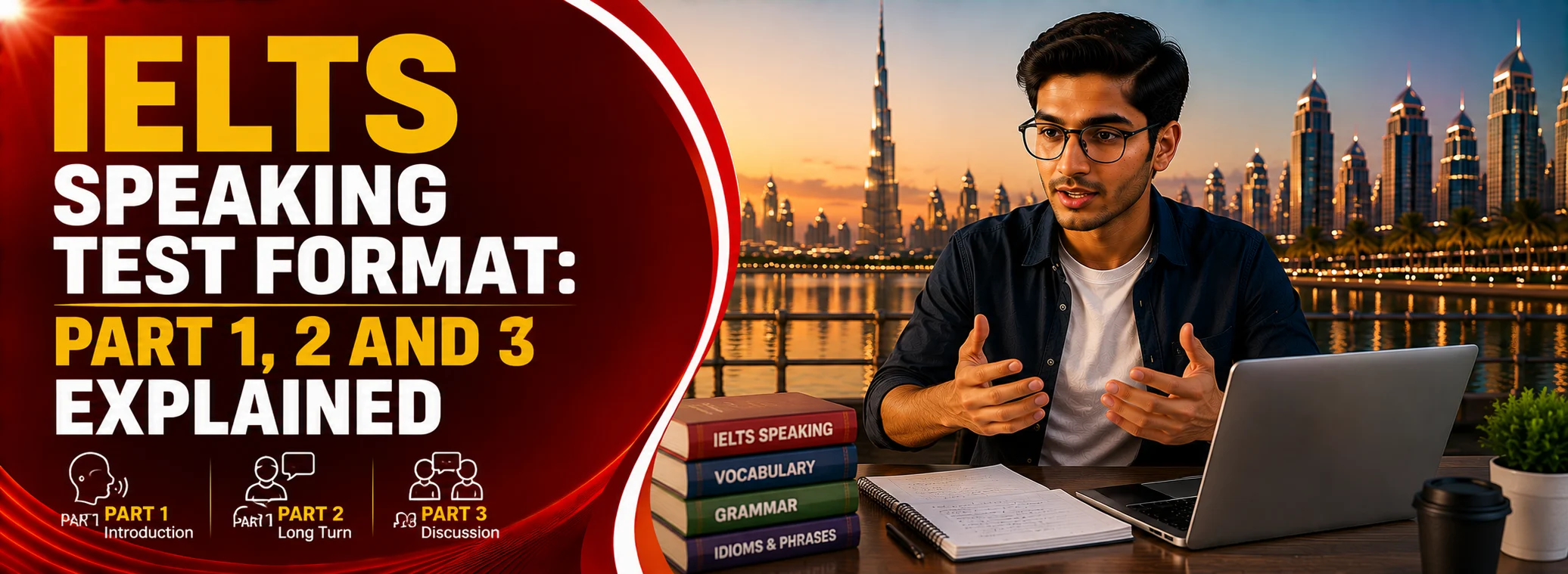
IELTS Speaking Test Format: Part 1, 2 and 3 Explained
Quick Overview
| Part | Duration | What It Tests |
|---|---|---|
| Part 1 | 4 to 5 minutes | Everyday questions about home, work and study |
| Part 2 | 3 to 4 minutes (incl. 1 min prep) | A 2-minute-long turn on a cue card topic |
| Part 3 | 4 to 5 minutes | A two-way discussion linked to Part 2 |
So What: Your final band rewards steady, structured speaking across all three parts, not clever vocabulary in a single answer.
Key Takeaways
- IELTS speaking lasts 11 to 14 minutes. Three connected parts make up the test, not three separate ones.
- Your band comes from the average of four criteria. One weak area can really bring down your score.
- From September 2026, the IELTS in India is going to be given on a computer. The IELTS speaking round will still be done live. This means it will happen face to face or over a video call.
- The universities in the UAE look at your IELTS speaking score as part of the IELTS score they need from you. Most of the time they want you to have a score between 5.0 and 6.5 for the IELTS. This depends on the programme and level.
- Structured practice on IELTS speaking Part 1 topics, Part 2 cue cards and Part 3 discussion questions moves your score faster. Memorised scripts do not.
Introduction
You open your IELTS score report. Everything looks fine until you reach the speaking column. Seventy-six per cent of Indian working professionals say limited English fluency holds back their career growth. This comes from British Council India. That gap usually shows up first in the IELTS speaking test. This is the one part of the exam where a real examiner listens to you. The examiner scores you as you talk.
If a UAE university sits on your list, this band carries extra weight. It confirms your academic English. It also often decides whether you walk straight into your degree or spend a semester in a foundation English programme first. Most guides online still list outdated cue cards. They stop there. This guide walks through the exact IELTS speaking format for 2026. It covers the four scoring criteria examiners use. It also covers what changes now that IELTS in India moves to a computer-delivered test.
Before you start practising, check how your target UAE university actually weighs this score. IELTS score requirements for UAE universities vary by programme and level. Knowing your target band early will save you from taking a retake later.
Planning to Study in the UAE? Let Us Guide You the Right Way.
What Happens in IELTS Speaking Part 1
IELTS speaking part 1 opens with an identity check. Then come warm-up questions on two or three familiar topics. When you are talking to the examiners, they usually want to know about your home, your family, your work or what you are studying and what you do every day. This part of the conversation is pretty short; it only takes about 4 to 5 minutes.
You do not have to talk a lot about each thing; the examiners just want to hear a bit about your home, your family, your work or studies and your daily routine.
Two to three sentences per answer work well. Add a small reason or example to each one. Take a student who asked about their hometown. That student does better by naming the city, adding one detail and moving on. Trailing off mid-sentence does not help.
Common IELTS speaking part 1 themes include the following:
- Your studies, work and daily routine
- Your hometown, neighbourhood and family
- Hobbies, food, technology and free time
- Weather, transport and shopping habits in your area
Nervous candidates often over-explain this section. They don’t have things to say later. Treat Part 1 as a warm-up, not the main event.
The Long Turn: IELTS Speaking Part 2 Cue Card Round
So IELTS speaking part 2 is like a part where you have to talk for a long time. The person who is asking you questions will give you a card. On this card there will be a topic and some other smaller points, three or four, that you need to include in your talk. You get one minute to prepare notes on paper. After that, you speak for one to two minutes without interruption.
Cue cards fall into a handful of repeating categories. Think of a person, a place, an object, an event or an experience. A typical prompt reads something like, 'Describe a skill you learnt recently.' It then asks what the skill was. It asks how you learned it. It asks how it helped you.
Structure decides this round more than vocabulary does. A short introduction works well. Add two or three main points with examples. End with a brief closing line. This structure fills the two minutes cleanly. Stopping under ninety seconds signals to the examiner that you ran out of content. That affects your fluency score.
IELTS Speaking Part 3: The Discussion That Decides Your Band
IELTS speaking part 3 moves the conversation from personal experience to broader ideas connected to your Part 2 topic. Say your cue card was about a skill you learned. Part 3 might ask how technology changes the way people learn skills today. It might also ask whether schools teach the right skills for future jobs.
This part lasts 4 to 5 minutes. It expects fuller answers, often close to a minute each. When you are talking to the examiners, they want you to be able to explain the English language exam. They want you to compare ideas and justify what you think about the English language exam. You have to speculate about what might happen in the future of the English language exam. It is not enough to state a fact about the English language exam.
When people do Part 3 of the English language exam, they often make a mistake. They repeat what they said in Part 2 of the English language exam by looking at the bigger picture of the English language exam. The Part 3 answers of the English language exam that are not good tend to repeat the story from Part 2 of the English language exam.
How IELTS Speaking Band Descriptors Decide Your Score
The IELTS speaking test has four things that the examiner looks at. Each of these things is worth 25 per cent of your IELTS speaking band score.
- The IELTS speaking test looks at your fluency and coherence. This means how smoothly you can speak and how your ideas are connected in a way.
- Then there is the resource. This is about the words you use and how accurately you use them. It is also about how you can say things in different ways.
- The IELTS speaking test also looks at your range and accuracy. This means what different types of sentences you can make and if they are correct.
- The last thing is your pronunciation. This is about how clear you are when you speak and if you use the right stress and intonation. The IELTS speaking test wants to know if people can understand you easily.
Your examiner scores each criterion from 1 to 9. The average becomes your final speaking band. This gets rounded to the nearest half band. Take a candidate scoring 7, 6, 7 and 6 across the four areas. That candidate ends up with a 6.5 overall. The published IELTS speaking band descriptors from British Council spell out exactly what separates a Band 6 answer from a Band 7 one. It is worth reading through them once before your test.
This score then feeds into the wider UAE admission process for Indian students. Your speaking band is with your transcripts, statement of purpose and visa documents. When a university requires a band of 6.0, it may also want a score for the IELTS speaking test. You should check the website of the university you want to apply to for the programme you're interested in, rather than just looking at the average IELTS score.
Face-to-Face or Video Call: What Changes for the 2026 IELTS Speaking Test
Some old guides do not have the information. IDP has said that IELTS in India will be fully computer-based from September 2026. This means that IELTS will not be on paper in India anymore. The listening, reading and writing parts will be on a computer. The IELTS speaking test will stay the same. It will still be a conversation with a person who is a certified examiner.
The only thing that has changed is how you take the test. At a growing number of Indian test centres, this conversation now runs as a video-call speaking test. You sit in a test room. You speak to your examiner over a secure, high-definition video link. This replaces sitting across a table. The three-part structure, timing and band descriptors stay identical between the two delivery modes. Your score is not affected by which one you get. If your test centre offers a choice, pick whichever setting makes you feel more comfortable.
Is studying in UAE worth it?
Check your starting salary, savings in ₹, and recovery timeline in months. Built for Indian subcontinent students.
Calculate ROI NowCommon IELTS Speaking Topics for Part 1, Part 2 and Part 3
IELTS does not tell you what you will be asked in the speaking part ahead of time. You will not find a list that says what questions you will get. Some things are always talked about, like certain subjects that come up every year. It is better to learn about a lot of things so you can talk about them easily than just memorising a few sentences.
Frequent IELTS has some speaking topics that come up a lot. They are usually about these things:
- Part 1 is about your life, like where you live, what you do for work or study, what you like to do in your time, what you eat, how you use technology and get around
- Part 2 is about telling a story, like talking about someone important to you a place that you love, something new you learned how to do a book or movie you liked or a special day that people celebrate in your country
- Part 3 is like part 2. The thing is, it is more about how things affect the International English Language Testing System or the way the internet is changing the way we learn and how people do things differently from one generation to the IELTS. These are all International English Language Testing System speaking topics.
When you look for International English Language Testing System speaking topics with answers, you should use them to study how to structure your answer and the different words you can use. You should not use them to learn the answers by heart. The people who mark the IELTS in 2026 are trained to notice when someone is just repeating something or has just memorised something. If you just say something without feeling it, it will hurt your score for how you speak and how well your thoughts are connected, and this happens even when the content itself sounds polished.
How to Prepare for IELTS Speaking
To do well in IELTS speaking, you need to make speaking a thing. This means you should speak loudly every day. You should also record yourself speaking. Then you should get feedback on how you're doing using the actual IELTS band descriptors. Do not just ask a friend what they think.
A good daily routine for IELTS speaking practice is like this:
- You should practise IELTS speaking Part 1 topics every day. Choose two or three topics. Speak about them until your answers sound natural and not like you are reading from a script.
- You should use cue cards. Time yourself. This will help you get used to speaking for two minutes.
- You should record yourself speaking. Then listen to the recording. Pay attention to when you hesitate or repeat words. Say things incorrectly. IELTS speaking practice is important to do every day. IELTS speaking practice will help you in the IELTS speaking test.
- Practise Part 3 questions on the same topics, since this is where most Indian candidates lose the most marks.
Many students search for structured question banks. This search often includes the Makkar IELTS speaking PDF and the Liz IELTS speaking material. Students hunt for topic-wise practice in one place. These resources are widely used. They offer help with structure and vocabulary ideas. They are not official IELTS material, though some circulating PDFs still reflect older exam patterns. Cross-check anything you download against the current format on the IELTS website or IDP before you rely on it. This step matters even more with the 2026 changes to delivery. It also matters with the stricter check on memorised answers. Structured coaching platforms built around the IELTS speaking criteria, sometimes marketed under names like IELTS Advantage, work on the same principle. They build consistent practice measured against the four official bands, not shortcuts.
Do You Need Idioms for IELTS Speaking
Idioms for IELTS speaking get requested often. The honest answer sits in the middle. The lexical resource descriptor rewards natural idiomatic language at Band 7 and above. Using an expression correctly and in the right context does help.
Forced or misused idioms hurt you more than they help, though. An examiner notices instantly when an idiom sounds memorised. The same happens when it gets dropped into an answer where it does not fit. This reads as unnatural rather than advanced. A safer way is to start by creating natural word combinations and phrases that're specific to the topic of discussion. The topic requires words. Words, like "strike a balance" or "a steep learning curve", are examples of natural word combinations. The topic needs these natural word combinations. Use these natural word combinations when the sentence really needs them to make sense. The topic is the focus. Being smooth and clear with regular English gets results rather than a rigid answer filled with copied expressions.
How Study From UAE Fits Into Your IELTS Speaking Preparation Timeline
Your target IELTS speaking band should not sit in isolation from your university shortlist. Requirements shift by programme, by level and sometimes by intake. Studying for a 6.5 when your target course only needs a 5.5 costs you time. That time could go elsewhere in your preparation. The Find Your University Quiz on Study From UAE lines up your expected IELTS band, budget and subject interest against more than 100 UAE universities in a single pass. Your speaking preparation then targets an actual number instead of a guess.
Conclusion
The IELTS speaking test rewards steady preparation across all three parts. It rewards this more than a big vocabulary list learned the night before. Know the format. Understand what each of the four band descriptors actually measures. Practise out loud against real time limits. Once your target band feels realistic, match it against the specific UAE programmes on your list. Requirements vary more than most students expect. If you want a second opinion on which programmes fit your current or target score, book a free session with a Study From UAE counsellor. Get a clear, personalised path from your IELTS score to your UAE admission offer.
 FAQs

 Previous Blog









 Log in with Google


