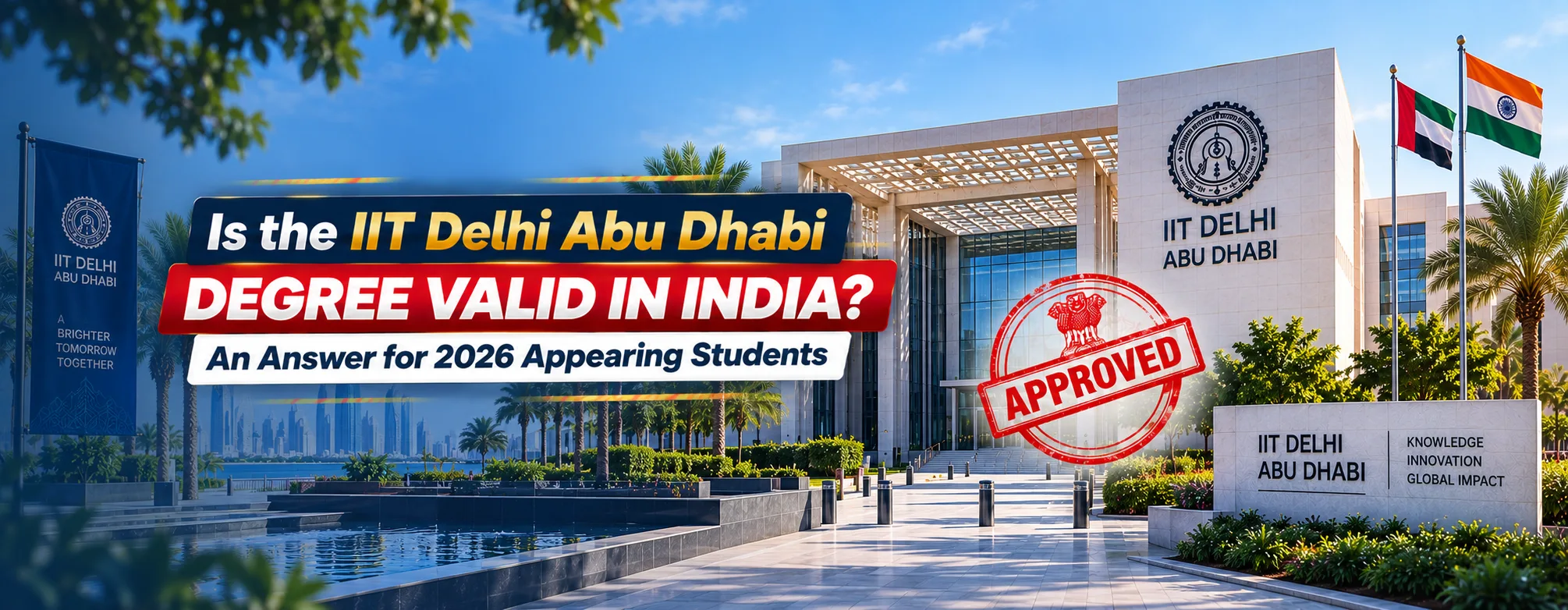
Is the IIT Delhi Abu Dhabi Degree Valid in India?
Quick Answer
Key Takeaways
- IIT Delhi gets its power to award degrees from the Institutes of Technology Act, 1961. It doesn't need separate approval from UGC, India's main higher-education regulator, the way a regular university does.
- The Association of Indian Universities lists IIT Delhi Abu Dhabi and IIT Madras Zanzibar as Indian universities' own campuses abroad, not as foreign institutions that need a recognition certificate.
- Total campus enrollment across all programmes, B.Tech, M.Tech, and PhD combined, reached 182 students by 2025-26, with the institute projecting around 400 for 2026-27.
- Annual tuition for AY2026-27 is AED 77,500. JEE Advanced qualifiers pay the Delhi-campus rate instead, which works out to roughly a 90-100% waiver on that figure.
- The first B.Tech batch graduates in 2028. No placement data or average package figures exist yet for this campus.
- After all admission rounds, including IIT-run special rounds beyond JoSAA's standard six, CSE at the Abu Dhabi campus closed at rank 6,772 for 2025, against the Delhi campus's closing rank of 126 for the same branch.
Introduction
Your cousin got into IIT Delhi's Abu Dhabi campus through JEE Advanced. Now your uncle wants to know if it's a "real" IIT degree or something watered down. That's a fair thing to ask. New "IIT" and "IIM" sounding names have popped up in India over the years, and not all of them turned out to be what they claimed.
This one is different, and you don't have to take anyone's word for it. The answer is written into Indian law. IIT Delhi Abu Dhabi isn't a joint venture or a licensing deal. It's IIT Delhi itself, working from a second address, giving out the same degree. Here's where that claim comes from, and here's what you should actually worry about instead.
Note: Talk to a Study From UAE counsellor about IIT Delhi Abu Dhabi's admission routes, fee waivers, and how it stacks up against other UAE engineering options.
Planning to Study in the UAE? Let Us Guide You the Right Way.
Why This Degree Doesn't Need UGC Approval
Most Indian universities need UGC's sign-off to award valid degrees. UGC checks their infrastructure, faculty, and courses, then gives them a green light.
IITs never went through that process, and they don't need to. IIT Delhi's right to give out degrees comes from its own law, the Institutes of Technology Act, 1961. This same law also names IITs as "Institutes of National Importance," a legal label given to a short list of institutions by Parliament itself. That list includes IITs, IIMs, AIIMS, and a few others.
Because of this law, IITs get something called Section 22 status under the UGC Act. In plain terms, the law itself permits them to award degrees. They don't need to go through UGC's usual approval process the way a private or state university does.
This becomes significant as IIT Delhi Abu Dhabi is not an institution which has recently sprung up to seek approval from India. It is the same old IIT Delhi but with a difference that apart from Delhi, now it teaches in Abu Dhabi too under the same 1961 Act. Shantanu Roy, who runs the Abu Dhabi campus, put it simply. He said, "We are actually one institution, and not two different institutions," in comments picked up by Study From UAE's guide to the campus.
Note: Institute of National Importance is a real legal category, not a phrase colleges use loosely. It only applies to institutions named directly in an Act of Parliament. Don't assume every college calling itself "national" or "international" carries this status.
Why AIU Treats This Differently From a Foreign Degree
If you've looked into studying abroad before, you've probably come across the Association of Indian Universities, or AIU. They check foreign degrees and issue something called an equivalence certificate. That's a document saying a foreign degree counts as equal to an Indian one, for jobs or further study.
IIT Delhi Abu Dhabi doesn't need this certificate. Here's why. AIU treats a degree from a foreign university very differently from a degree that an Indian university awards at its own campus abroad. The first case needs checking. The second doesn't, as long as the Indian institution already had valid Indian government approval to run that programme in the first place.
AIU's own published records back this up. Their list of "Indian Universities establishing Campuses in Foreign Countries" names IIT Delhi's Abu Dhabi campus and IIT Madras's Zanzibar campus directly, alongside private Indian institutions like Manipal and BITS Pilani that have taken their own UAE campuses down a different route. AIU sees IITD-AD as an Indian degree that happens to be taught abroad, not a foreign degree that needs a stamp of approval.
This doesn't mean every UAE branch campus works the same way. Manipal, BITS Pilani, and Amity run their Dubai campuses under a different approval route through UGC. Their degrees are also valid, just through a different door. In case you have to choose between the options, see which door suits the particular university you are applying for. It is not the same everywhere.
What "Same Degree" Actually Looks Like on Paper
In practical terms, a B.Tech in Computer Science earned in Abu Dhabi says Indian Institute of Technology Delhi on the certificate. Same as one earned in Delhi. There's no separate tag marking it as the Abu Dhabi version.
There's a second layer worth knowing. All four undergraduate programmes also hold accreditation from the UAE's Commission for Academic Accreditation, confirmed on the official undergraduate programmes page. So you get Indian legal recognition through the 1961 Act, and UAE recognition through this accreditation, at the same time. That second part matters if you ever want to work or settle in Abu Dhabi after graduating, since local employers check for this accreditation as standard practice.
How This Degree Actually Gets Verified
One question almost nobody answers clearly. If an employer or a government office wants to verify this degree, where do they even send the request?
As IIT Delhi Abu Dhabi is a legal part of IIT Delhi and not an independent institute, the verification should follow the process that is adopted for all other degrees from IIT Delhi. The IIT Delhi central academic department in Delhi does all the verifications and issues the transcripts of convocation from all the IIT Delhi programmes regardless of whether it was pursued from Hauz Khas or Khalifa City. The exact process for Abu Dhabi graduates will only be tested in practice once the first batch actually graduates in 2028, but there's no legal reason it would work any differently from verification for a Delhi degree.
The Real Thing to Worry About: Track Record, Not Validity
Here's where your attention should actually go, and it has nothing to do with whether the degree counts.
First-year undergraduates were admitted in the academic year of 2024-25. A B.Tech is a four-year course; therefore, the first graduating batch will leave in 2028. Until then, nobody has real placement numbers, real average salary figures, or years of alumni to point to. If anyone quotes you an "average package" for this university campus right now, they are just copying Delhi’s figures but claiming that they are those of Abu Dhabi. They are not.
What the campus does have is momentum, and it's worth being precise about what that number actually measures. As per the report by Executive Director Shantanu Roy to the visiting media in December 2025, the total number of enrollments in all programs offered by IITD-AD, including undergraduates, M.Tech, and PhDs, is 182, and the institute is expecting a figure of around 400 enrollments in 2026-27. But it's a genuine, sourced signal that the campus is scaling rather than stalling.
That's not a knock on whether the degree is valid. It's a gap in what the degree has actually shown in the job market so far, which is a completely different question from what it's legally entitled to.
Second honest point. The campus is still temporary. It currently runs out of space borrowed from Zayed University in Khalifa City. A permanent campus is planned, but it's still years away, by most reports. If a fully built-out campus and a long alumni history matter to you, that's a real trade-off here. It's a lifestyle and network question, not a legal one.
Third, worth knowing if you're looking past undergrad: the same "new but expanding" pattern shows up in IITD-AD's graduate offerings. Beyond the four B.Tech branches, the campus now runs two M.Tech programmes (Energy Transition and Sustainability, and the newer Machine Intelligence and Data Science) and three PhD programmes (Energy and Sustainability, plus Computer Science and Artificial Intelligence and Natural Sciences, both added in 2026). The same validity logic applies to every one of these: they're IIT Delhi degrees, not separate qualifications, and they carry the identical track-record caveat.
Admission and Cost, in Brief
Since the validity question usually comes with a follow-up, "can I even get in, and what does it cost?", here's the short version. For the full breakdown of both admission routes and every scholarship detail, Study From UAE's dedicated IIT Delhi Abu Dhabi guide covers that ground in depth. This section sticks to what a parent doing quick budget math actually needs.
Tuition for AY2026-27 is AED 77,500 a year, per IITD-AD's own current fee page. What you actually pay depends heavily on your admission route:
| Route | Tuition waiver | Monthly support |
|---|---|---|
| JEE Advanced (Indian nationals) | ~90-100% (pays Delhi-campus fee instead) | AED 750 allowance + AED 2,250 boarding, AED 3,000+ total |
| CAET, International/Indian Expat | 75% flat waiver* | AED 2,250 boarding, AED 2,500+ total |
| CAET, UAE Nationals | 100% waiver | AED 2,750 allowance + AED 2,250 boarding, AED 5,000+ total |
Note: The 75% waiver for International and Indian Expatriate CAET admits is a flat rate under the current AY2026-27 policy, with no CGPA tiers. An earlier CGPA-tiered structure (100% waiver at 8.0+, 50% at 6.0-7.99) applied only to the batch that entered in 2024 and has since been superseded on IITD-AD's own site.
JEE Advanced admits also get two funded round-trip home tickets a year, medical insurance, and visa and Emirates ID processing covered. CAET admits get the same tickets and insurance, minus the ticket benefit for students already resident in the UAE.
On cutoffs, the number that matters depends on which count you're looking at. Within JoSAA's own six standard counselling rounds, the 2025 cycle closed CSE at rank 1,346 in round one, widening only slightly by round six. But IITD-AD then ran its own additional special rounds to fill remaining vacancies, and its official Round 1–10 tally shows the true final closing rank for CSE at 6,772, and for Energy Engineering at 7,885. "Chemical Engineering" does not figure in that special round's document at all. In other words, Chemical Engineering was filled up entirely in the regular rounds of JoSAA, closing at 5,712. Stated in other terms, the actual difference in ranks for getting a CSE seat in IIT Delhi, Delhi campus (which closes at 126) versus getting a CSE seat in Abu Dhabi campus is a lot higher than suggested by JoSAA figures alone, and not lower.
If you want to work out whether this fits your actual budget, or you're weighing IITD-AD against other UAE options, Study From UAE's ROI Calculator is built for exactly this kind of side-by-side planning, especially to check the budget and the returns on investment for the course completion.
Is studying in the UAE worth it?
Check your starting salary, savings in ₹, and recovery timeline in months. Built for Indian subcontinent students.
Calculate ROI NowConclusion
The degree itself isn't the risk here. It's IIT Delhi's degree, backed by the same law that backs every IIT credential in the country. It’s the timing that really counts: an institution trying to scale its total enrollment up to 400 but without any placement record, which is running out of borrowed space, and won’t have any graduates till 2028. If you're weighing IIT Delhi Abu Dhabi against other engineering options in the UAE before you apply, Study From UAE's engineering course listings let you compare accreditation, fees, and programme depth in one place, so you're deciding with facts instead of guesswork.
 FAQs

 Previous Blog








 Log in with Google


