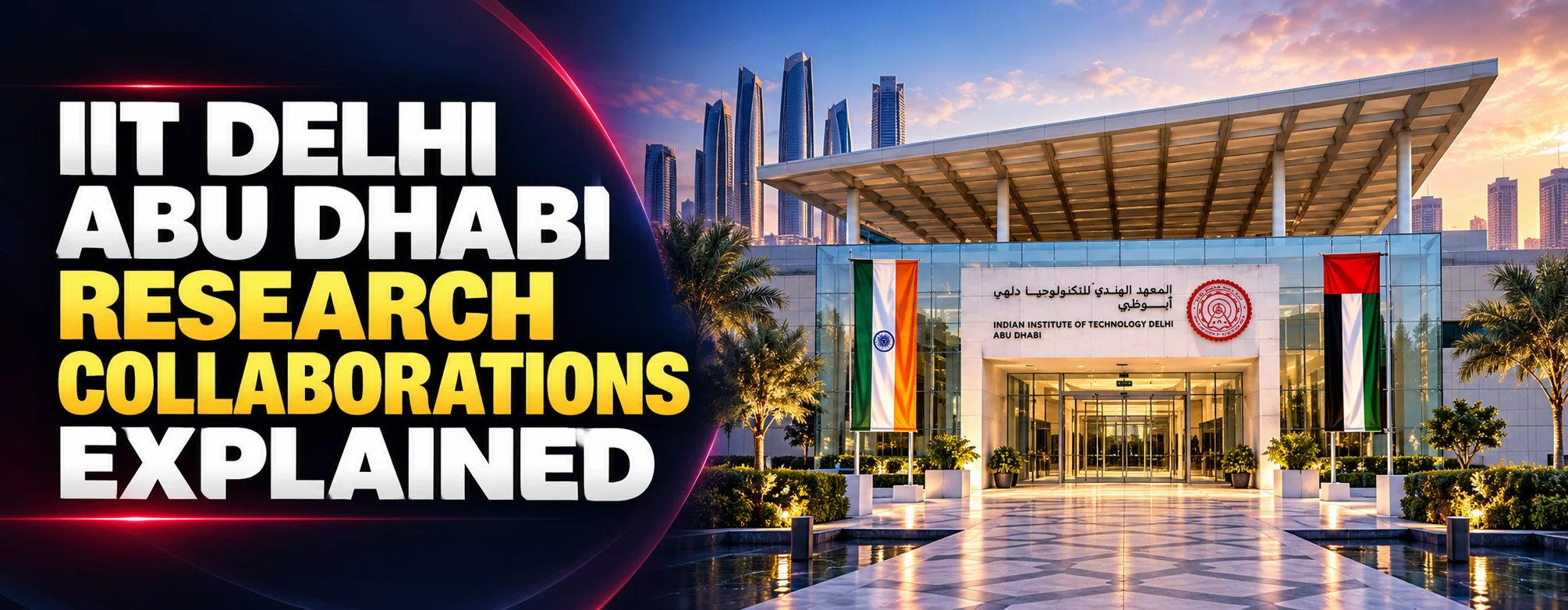
IIT Delhi Abu Dhabi Research Collaborations: What They Actually Mean for You
Quick Answer
Key Takeaways
- IIT Delhi's Abu Dhabi campus has signed research MoUs with four UAE institutions: Khalifa University, MBZUAI, Sorbonne University Abu Dhabi and Zayed University..
- Joint projects are funded under MFIRP, where IIT Delhi puts in Rs 10 lakh and the partner matches it, totalling about Rs 20 lakh per project across two years.
- Two live MFIRP projects with MBZUAI cover AI-designed materials for carbon capture and digital twins for power grids, both running 2025-26.
- Annual B.Tech tuition is AED 77,500 for 2026-27; Indian expatriates and international students get a 75% waiver.
- Indian citizens living in India cannot use the CAET route. That pathway needs five years of schooling outside India, so JEE (Advanced) is the only door.
- The campus still operates from an interim facility inside Zayed University's Khalifa City B premises, and roughly 400 students is a stated target rather than current enrolment.
Introduction
You've seen the headline. IIT Delhi opened a campus in Abu Dhabi, signed agreements with four universities in the emirate, and everyone called it historic.
What nobody explains is whether any of it reaches you. IIT Delhi Abu Dhabi research collaborations get announced in language built for ministers, not for a 17-year-old deciding where to spend four years. So the student reads about frameworks and joint initiatives and still has no idea whether they'll ever walk into a Khalifa University lab or touch an MBZUAI-funded project. Some of this genuinely does reach students. A good chunk is faculty-only for now. And the campus is small enough that your answer changes depending on which programme you enter.
Below is what's funded, what's running, and what's still sitting on paper.
Planning to Study in the UAE? Let Us Guide You the Right Way.
Which Abu Dhabi universities does IIT Delhi Abu Dhabi work with?
IIT Delhi Abu Dhabi holds formal agreements with four institutions: Khalifa University, Mohamed bin Zayed University of Artificial Intelligence, Sorbonne University Abu Dhabi and Zayed University. All four were signed publicly at the campus inauguration on 2 September 2024, with Sheikh Khaled bin Mohamed bin Zayed Al Nahyan attending.
Each agreement does something different, and the differences matter more than the headline count.
| Partner institution | What the agreement covers | Where it surfaces for students |
|---|---|---|
| Khalifa University | Joint research and academic programmes, shared research facilities and lab space, faculty and student mobility | Joint symposia, lab access arranged through your supervisor |
| MBZUAI | Seed-grant joint research, joint teaching, short training programmes, internship hosting | Internships, and an AI master's under development |
| Sorbonne University Abu Dhabi | Joint research projects, postgraduate-level student exchange, scientific seminars and meetings | PG exchange, joint schools such as the Abu Dhabi School on Material Discovery |
| Zayed University | Faculty and student exchange, co-supervised graduation research, joint conferences and student competitions | Co-supervision, plus the physical campus you'd study in |
Agreement scope as published by IIT Delhi - Abu Dhabi and the Abu Dhabi Media Office, September 2024 onward.
Read that table for the middle column, not the first. Only two of the four give you a route to lab space or a supervisor, and only one names internships. If your reason for choosing Abu Dhabi is hands-on research access as an undergraduate, Khalifa University and MBZUAI are the two names that carry weight.
Worth noticing what's absent, too. None of these agreements promise a joint degree. You get an IIT Delhi degree, taught by IIT Delhi faculty, with collaboration happening around the edges of that.
What the MBZUAI partnership actually funds
Of the four agreements, the MBZUAI one is the easiest to trace to actual money. Seed project grants were named in the partnership from the start, and you can point to specific funded projects rather than stated intentions. Both institutions allocate those grants, and the mechanism is IIT Delhi's Multi-Institutional Faculty Interdisciplinary Research Projects scheme, better known as MFIRP. Plain version: a matching grant for two-institution teams.
Under MFIRP, IIT Delhi funds its own principal investigator with Rs 10 lakh and the partner institution matches that for theirs, so a project carries roughly Rs 20 lakh across two years. Small, by research standards. Deliberately so, since the design intent is to generate joint publications that then attract bigger external grants.
Two funded examples, both running 2025-26 and both spanning IIT Delhi, IITD-AD and MBZUAI. The first uses deep learning to design MOF and zeolite materials that adsorb CO2 more efficiently, which is carbon-capture chemistry driven by machine learning rather than trial and error. The second builds digital twins of power grids, meaning software replicas you can stress-test without touching the real network.
Faculty-led, both of them. As a student you reach work like this through a supervisor, not through an application form.
The other MBZUAI thread is teaching. Executive Director Shantanu Roy has said a master's programme in AI, already offered at the Delhi campus, is being started in Abu Dhabi in close alignment with MBZUAI. If AI is your target field and you want funded options while that programme settles, MBZUAI runs its own fully funded graduate route, and the MBZUAI scholarship structure for MSc and PhD applicants is a separate application worth understanding on its own terms.
Sorbonne and Zayed University: exchange, not engineering
These two agreements are narrower, and pretending otherwise would waste your time.
Sorbonne University Abu Dhabi's partnership covers joint research projects, student exchange at postgraduate level, and the organisation of seminars and scientific meetings. Note the postgraduate qualifier. A B.Tech student isn't the intended beneficiary. The visible output so far is jointly run scientific schools, including the Abu Dhabi School on Material Discovery. For anyone weighing the French-degree route separately, the Sorbonne University Abu Dhabi guide for Indian applicants covers fees and admissions in detail.
Zayed University's role is more practical than academic. It hosts IIT Delhi Abu Dhabi. The campus operates as an interim academic facility inside Zayed University's Khalifa City B premises. The agreement adds faculty and student exchange, co-supervision of graduation research, and joint conferences, seminars and student competitions. A Research Connect workshop with Zayed University ran on 4 May 2026 across AI, healthcare, energy systems and carbon capture.
Sorbonne University Abu Dhabi's agreement really serves postgraduate researchers. Zayed University's main contribution so far is the building itself.
How students actually get in, and the rule that catches Indian applicants
Two admission pathways exist for B.Tech, and only one of them is open to a student sitting in Pune or Chennai today.
CAET, the Combined Admission Entrance Test, is the campus's own exam, held across Abu Dhabi, Dubai, Sharjah, Ras Al Khaimah, New Delhi, Tokyo, Singapore and Muscat. Read the eligibility carefully. CAET is open to UAE nationals, international candidates, and Indian expatriates, defined as Indian passport holders who've lived outside India for the last five years and completed Class VIII to XII schooling outside India. An Indian student educated in India doesn't qualify, even with a New Delhi test centre available.
That student's only route is JEE (Advanced). IIT Delhi Abu Dhabi goes looking for those qualifiers in India, running sessions for students and parents in nine cities including Pune, Mumbai, Hyderabad and Bengaluru.
The financial picture splits along the same lines.
| Applicant category | Tuition position, 2026-27 | Monthly support |
|---|---|---|
| UAE nationals | 100% waiver | Above AED 5,000, including a AED 2,750 allowance |
| JEE (Advanced) qualified | Pays the IIT Delhi Delhi-campus fee, roughly a 90 to 100% waiver | Above AED 3,000, including AED 750 allowance plus two home flights a year |
| Indian expatriates and international | 75% waiver, leaving about AED 19,375 payable | Above AED 2,500, with AED 2,250 boarding support |
Fee and scholarship structure for academic year 2026-27, all figures in AED.
Run the JEE row properly and it's remarkable: you pay Delhi-campus fees, roughly Rs 2.5 lakh territory, and study in Abu Dhabi with accommodation and flights covered. The 75% waiver route leaves around Rs 4.5 lakh a year in tuition at current exchange rates, against a sticker price near Rs 18 lakh.
Note: These figures apply to the 2026-27 intake and are administered subject to eligibility, documentation and continued enrolment. Waiver percentages and allowances get revised between cycles, so confirm on the fees page before building a family budget on them.
Is studying in UAE worth it?
Check your starting salary, savings in ₹, and recovery timeline in months. Built for Indian subcontinent students.
Calculate ROI NowWhat these collaborations don't give you yet
Every article about this campus stops before the honest part, so here it is.
The academic menu is thin. At postgraduate level the official pages list one M.Tech, in Energy Transition and Sustainability, and one PhD, in Energy and Sustainability. The AI master's is announced, not listed. If your research interest sits outside energy, sustainability and adjacent materials work, the collaboration network won't fix a programme that doesn't exist yet.
Scale is the second issue. The inaugural M.Tech cohort in January 2024 had 17 students. Executive Director Shantanu Roy has described roughly 400 students as the target, not the current figure. Those numbers produce close faculty contact and thin everything else: societies, alumni networks, the informal senior-junior machinery that makes an Indian IIT campus work.
Placement history barely exists. The campus opened to undergraduates in September 2024, so no B.Tech batch has graduated into a published placement report. Named early outcomes exist, including an M.Tech alumnus who moved into solar project work, but a handful of individual results isn't a placement record.
And the campus itself is temporary. Roy has described it plainly as a transit campus with the permanent build still years out.
Against that, one thing is settled. The degree is an IIT Delhi degree, and IIT Delhi placed 118th globally in the QS World University Rankings 2027, India's highest-ranked institution for the second consecutive year, with IIT Bombay at 134th. You're giving up an established campus and getting the IIT Delhi name in a Gulf location instead. Whether that's a good trade depends on whether you need the degree or the network around it. Students comparing this against other engineering universities in the UAE with strong industry exposure should weigh a settled campus against a new one carrying a stronger name.
Where Study From UAE Fits Into This
Study From UAE is a university discovery and guidance platform built for students from India and the wider subcontinent who are looking at UAE higher education. We check programme details, fee structures and scholarship terms against official university pages, then help students work out what they're actually eligible for.
That second part matters more than usual on this topic.
Most of the confusion around IIT Delhi's Abu Dhabi campus has nothing to do with research quality. It's eligibility, and it costs families months. A student in Nagpur spends a year preparing for CAET, then finds the five-year overseas schooling condition sitting in the eligibility page and has to fall back on JEE (Advanced) with no plan in place. Another applies to a single Abu Dhabi institution because relatives recognise the name, when their research field sat closer to what Khalifa University or MBZUAI actually funds.
We cover all seven emirates, so a shortlist doesn't have to stop at one campus. You can read scholarship terms before applying rather than after, work through the UAE student visa documentation, and model total cost with housing and flights included instead of tuition alone.
Our position on research-led decisions is straightforward. Two well-matched applications beat one famous name.
Conclusion
Start by working out which pathway you're even eligible for, because that single check eliminates most of the confusion around IIT Delhi Abu Dhabi research collaborations. If you were schooled in India, CAET is closed and JEE (Advanced) is your route. If you're an Indian expatriate in the Gulf, both doors are open and the waiver maths differs sharply between them.
Then match your research interest against what's actually funded rather than what's been announced.
Send us your board results, your nationality and residency status, and the research area you want to work in. We'll tell you which pathway applies, whether IITD-AD's current programme list fits your field, and which Abu Dhabi alternative deserves a parallel application.
 FAQs

 Previous Blog







 Log in with Google


